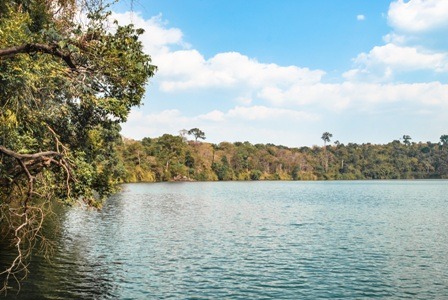
Chong Chom Border Checkpoint
The Chong Chom – O'Smach border crossing connects Thailand's Surin Province with northwestern Cambodia. Less crowded than Poipet, it offers direct access to Siem Reap via a rural road crossing the Oddar Meanchey plains.
The Chong Chom – O'Smach border crossing connects Thailand's Surin Province with northwestern Cambodia's Oddar Meanchey Province. It is one of the official land passages between the two countries, frequented by independent travelers, cross-border workers, and merchants. It offers direct access to Siem Reap via the national highway, without passing through Bangkok.
Practical Information at a Glance
- Crossing type: official international land border, open to foreign nationals with valid visas.
- Cambodian visa: available on arrival (visa on arrival) for most nationalities; electronic visas (e-visa) are also accepted.
- Documents: valid passport required; bring identity photos and US dollars for visa fees.
- Thai side: Chong Chom town, Kap Choeng District, Surin Province.
- Cambodian side: O'Smach, Oddar Meanchey Province.
- Crossing time: allow 30 to 90 minutes depending on traffic and document preparation.
What to See
The crossing itself is a modest administrative complex with immigration counters on both sides. On the Cambodian side, an informal market has developed around the passage: currency exchange stalls, local product shops, and small restaurants. The setting is rural, surrounded by agricultural plains typical of northwestern Cambodia.
History and Context
This border has long been a sensitive area due to armed conflicts that marked Cambodia until the 1990s. O'Smach was one of the last Khmer Rouge strongholds to fall, in 1999. The official opening of the crossing to foreign travelers came after the country's stabilization and the development of regional tourism.
Highlights of the Visit
The Border Market
O'Smach's market concentrates lively commercial exchanges between Thailand and Cambodia. You'll find foodstuffs, textiles, and various merchandise at competitive prices. It's a vivid glimpse into the region's informal cross-border economy.
The Road to Siem Reap
After crossing, the national highway passes through landscapes of rice paddies and sparse forests all the way to Siem Reap. This journey, lasting approximately five to six hours by bus or shared taxi, offers a view of rural Cambodia far from the usual tourist circuits.
Photography Tips
Avoid photographing official buildings, immigration counters, and uniformed officers on either side: it is prohibited and may cause complications. The market and surrounding rural landscapes are, however, accessible for photography.
Location and Access
On the Thai side, Chong Chom is accessible from Surin by bus or songthaew (approximately two hours). From Bangkok, direct buses serve Surin. On the Cambodian side, shared taxis and minibuses connect O'Smach to Siem Reap. There is no direct public transport between the border and Phnom Penh without a connection.
Nearby Attractions
- Temples of Angkor — approximately five to six hours' drive away, the main destination for travelers using this crossing.
- Siem Reap — the first major Cambodian city after the border, an essential base for exploring the region.
- Preah Vihear Temple — a Khmer site listed as a UNESCO World Heritage Site, accessible from northern Cambodia.
Frequently asked questions
Yes, visa on arrival is issued on the Cambodian side for most nationalities. Bring US dollars, identity photos, and your valid passport. A Cambodian e-visa is also accepted if you obtained it online before departure.
The crossing is passable year-round. During the rainy season (June to October), the road on the Cambodian side may be degraded in places; the dry season (November to April) offers more comfortable traveling conditions.
Shared taxis and minibuses wait on the Cambodian side to take you to Siem Reap. The journey takes approximately five to six hours depending on road conditions. Negotiate the price before boarding.
Chong Chom – O'Smach is significantly less crowded than Poipet, which reduces waiting times. However, it is less well-served by transport and the road to Siem Reap is longer. It is best suited for travelers coming from Surin or wishing to avoid the hustle of Poipet.
No. Official buildings, counters, and uniformed personnel must not be photographed. Respect this rule on both sides of the border to avoid any incidents.
Interested in this visit?
We can include it in your personalised itinerary.