Preah Monivong National Park
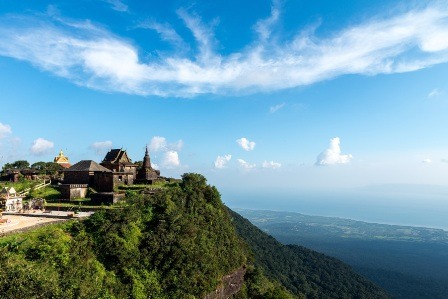
Perched over 1,000 metres above Kampot, Bokor National Park blends mist-shrouded colonial ruins, primary forest, and spectacular vistas across the Gulf of Thailand.
Preah Monivong National Park, more commonly known as Bokor National Park, sprawls across the highlands of Kampot Province in southern Cambodia. Rising above 1,000 metres in altitude on the southern Cardamom Mountains massif, it shelters dense forests, waterfalls, and the ruins of an abandoned French colonial station. The mist that regularly blankets the plateau bestows a singular atmosphere, strikingly different from the rest of the country.
Quick facts at a glance
- Access: paved road from Kampot, navigable by car, motorbike, or tuk-tuk; the ascent takes roughly 30 to 40 minutes from town.
- Entrance: park entry fee applies (rates subject to change; verify on-site).
- Recommended duration: half-day to full day depending on sites visited.
- Clothing: warm garments recommended at altitude, especially early morning or during rainy season.
- Accessibility: limited on natural trails; the main road and certain viewpoints are accessible by vehicle.
What to see
The Bokor plateau concentrates several distinct points of interest. The ruins of the former French colonial station—the Bokor Palace hotel, an abandoned Catholic church, a casino—contrast strikingly with the tropical vegetation gradually reclaiming them. Popokvil Waterfall, reachable on foot from the plateau, offers a refreshing respite. The primary forest harbours protected wildlife: elephants, leopards, gaurs, and numerous bird species.
History and context
The Bokor station was constructed by the French colonial administration in the 1920s as a climatised refuge for European residents escaping the heat of the lowlands. It was abandoned multiple times: following Cambodian independence, then during the conflicts of the 1970s–1990s. The Khmer Rouge established defensive positions here, leaving the site in progressive disrepair. A portion of the plateau was subsequently granted as a concession to a private group, which developed a modern hotel complex and casino, coexisting alongside the historical ruins.
Highlights of the visit
Bokor Palace
This former grand colonial hotel, built in 1925, overlooks the cliff face with vistas across the Gulf of Thailand. Its crumbling façades and empty halls speak to decades of abandonment. Access to the interior may be restricted depending on the period.
The abandoned Catholic church
Erected at the same time as the hotel, this small stone church ranks among the site's most photographed images. Morning mist intensifies its air of a place suspended in time.
Popokvil Waterfall
Accessible from the plateau via a marked trail, this two-tiered waterfall is particularly striking during rainy season (June through October). Swimming is possible in the lower pools.
Viewpoints over the Gulf of Thailand
On clear days, vistas from the plateau's edge sweep across the Cambodian coast, surrounding islands, and distant Thailand. Sunrise from these heights is particularly dramatic.
Photography tips
Morning light, before mist rises, creates dramatic atmospheres around the colonial ruins. In dry season, clear skies favour coastal panoramas from the viewpoints. For Popokvil Waterfall, prioritise rainy season for maximum flow. Avoid midday, often overcast or too harsh.
Location and access
Bokor National Park lies roughly thirty kilometres from Kampot, reached via a paved mountain road. From Kampot, tuk-tuks, motorbikes, and cars with drivers offer the ascent. It is also possible to rent a motorbike in Kampot for independent access. The park is approximately two hours' drive from Sihanoukville.
Nearby
- Kampot — colonial riverside town, the ideal departure point for visiting Bokor, renowned for its pepper plantations and laid-back atmosphere.
- Kep — former Cambodian beach resort about thirty kilometres away, celebrated for its crabs and seafood market.
- Sihanoukville — the country's principal port and beach resort, gateway to the Gulf of Thailand islands.
Frequently asked questions
Dry season (November through April) offers optimal conditions for coastal panoramas. Rainy season (June through October) is ideal for viewing Popokvil Waterfall at maximum flow, though mist may limit visibility.
Independent exploration is feasible; the main road and principal sites are well signposted. A local guide remains valuable for hiking forest trails and understanding the colonial site's history.
Yes, by departing Kampot early. Plan for a half-day on the plateau, leaving the afternoon for exploring Kampot town and its surroundings.
Temperatures are noticeably cooler than in the lowlands, particularly early morning and during rainy season. A pullover or light jacket is recommended, even in dry season.
Photography is generally allowed in outdoor areas of the ruins. Access to building interiors may be restricted; observe signage on-site.
Interested in this visit?
We can include it in your personalised itinerary.