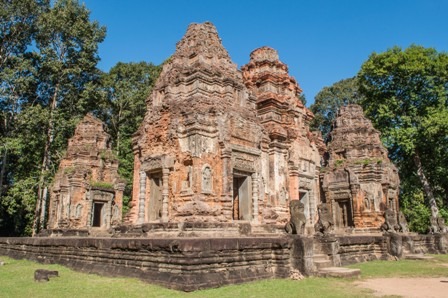
Pre Rup
Pre Rup
State temple of King Rajendravarman II constructed in 961, Pre Rup rises its laterite pyramid east of Angkor, prized for its panoramic sunset views.
Pre Rup is a temple-mountain within the Angkor complex, built in the 10th century during the reign of Rajendravarman II. Its pyramidal silhouette of laterite and brick, rising east of the Eastern Baray, makes it one of the major stops on the Grand Circuit, particularly valued at day's end for the view it commands over the Angkorian plain.
Why visit Pre Rup
Pre Rup combines three assets that distinguish it within a visit to Angkor. Its elevated pyramidal structure provides a rare, unobstructed vantage point over the rice paddies and surrounding canopy. Its reddish hue, born of laterite and fired brick, shifts in tone with the light, making it a sought-after site in late afternoon. Finally, its complete and legible layout allows one to grasp the Khmer conception of the temple-mountain—a symbol of Mount Meru—without the crowds that characterize more central monuments.
The temple's history
Pre Rup is the state temple of King Rajendravarman II, built in 961. It mirrors the same dimensions and plans as the Eastern Mebon, erected 8 years earlier by the same sovereign. Rajendravarman II restored the Khmer capital to Angkor, 16 years after Jayavarman IV had moved it to Chok Gargyar (Koh Ker). The major difference from the Eastern Mebon lies in the pyramidal base, a symbol of Mount Meru representing the center of the world in Hindu belief, rising far more prominently from ground level.
The name "Pre Rup," which may be translated as "turn the body," long suggested a funerary purpose connected to cremation rites, though historians now debate this hypothesis. In any case, the structure marks a milestone in Khmer art's evolution, midway between the massive volumes of Koh Ker and the refinement soon to come with the Baphuon.
What to see on site
The summit sanctuaries
Five sanctuaries rise at the pyramid's summit. Two structures are devoted to Shiva (member of the Trimurti, symbol of restorative destruction): one houses a statue of Shiva represented in the form of the king, following the common practice of royal deification of the era. The south-eastern sanctuary is dedicated to Vishnu, protector deity of the Trimurti. The two western sanctuaries are dedicated to Uma and Lakshmi (consorts of Shiva and Vishnu).
Later additions
Five further sanctuaries were added on the eastern portion of the base during the reign of Jayavarman V, also devoted to Hindu deities. Notably, one vacant spot marks a sixth sanctuary that was never completed, a rare testament to an unfinished project.
Details to observe
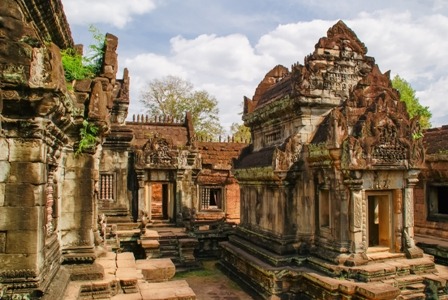
- The gopuras (monumental porches) marking the entrance axes, adorned with carved lintels.
- The laterite guardian lions flanking the pyramid stairs.
- The rectangular sandstone basin at the foot of the edifice, sometimes mistakenly associated with a funerary function.
- The finely decorated false doors on the brick sanctuaries.
- The panoramic view from the summit terrace, toward the Eastern Mebon and Angkor's canopy.
When to visit Pre Rup
Late afternoon is the preferred visiting time: raking light accentuates the red tone of the laterite and offers a sunset appreciated from the summit, a quieter alternative to Phnom Bakheng. Early morning remains pleasant for a more peaceful and photographic visit, without backlighting. The dry season, November through March, remains the most comfortable period, with bearable temperatures and little rain. The green season (June to October) offers lush vegetation around the site, at the price of occasional showers late in the day.
Practical information
- Admission: visiting requires the Angkor Pass, valid for the entire archaeological park (1, 3, or 7 days).
- Duration: allow 30 minutes to 1 hour on site, longer if waiting for sunset.
- Hours: the site opens early in the morning and closes shortly after sunset, like the rest of Angkor park.
- Advice: wear closed-toe shoes (steep stairs), bring water, hat, and clothing covering shoulders and knees out of respect for the site's sacred character.
How to get there
Pre Rup lies approximately 12 kilometers northeast of Siem Reap, in the eastern section of Angkor park. The temple is featured on the Grand Circuit (Big Circuit), typically traveled by tuk-tuk, private vehicle with driver, or bicycle for athletic visitors. From Siem Reap, expect approximately 30 to 40 minutes by tuk-tuk. The site is often visited late in the day following a morning visit to the Eastern Mebon or Ta Som, located in immediate proximity.
What to see nearby
- Banteay Samre, a remarkably well-preserved 12th-century Hindu temple, a few kilometers to the east.
- Baphuon, another temple-mountain within Angkor Thom, complementary for understanding architectural evolution.
- Bakong, the earliest Khmer temple-mountain of the Roluos group, built some 80 years before Pre Rup.
Frequently asked questions
Sunset remains the most appreciated time, thanks to warm light revealing the laterite and the unobstructed view from the summit. The morning visit, however, offers greater quiet and favorable light for photographing the sanctuaries on the eastern side.
Allow 30 minutes to 1 hour to tour the sanctuaries and climb to the summit. If staying for sunset, plan 1.5 to 2 hours, arriving roughly an hour beforehand.
No, the Angkor Pass, common to the entire archaeological park, suffices. No additional ticket is required for this temple.
Interested in including Pre Rup in a bespoke journey through Khmer temples and Cambodian landscapes? Discover our suggested itineraries on our travel to Cambodge page.
Nearby
Interested in this visit?
We can include it in your personalised itinerary.