Bayon Temple
Bayon Temple
At the center of Angkor Thom, Bayon rises with its face-towers and 1,200 metres of Khmer bas-reliefs. Complete guide: history, architecture, practical visit.
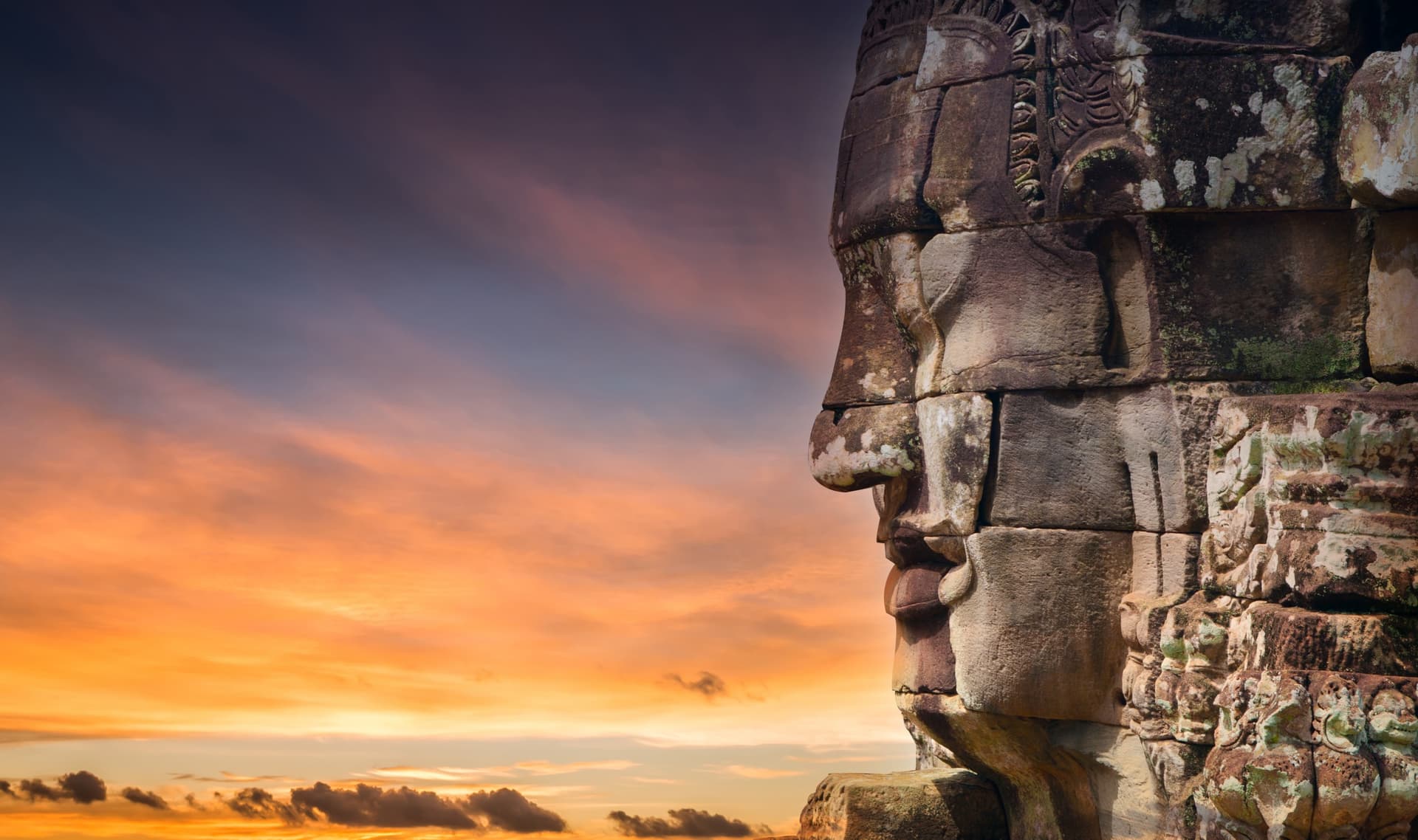
At the geometric centre of the ancient fortified city of Angkor Thom, Bayon temple is instantly recognisable by its face-towers oriented towards the four cardinal points. A temple-mountain dedicated to Mahayana Buddhism, it was built around the early 13th century under the reign of Jayavarman VII and represents the last temple-mountain of the Khmer empire. Its dense structure, bas-reliefs spanning nearly 1,200 metres, and stone figures make it one of the most studied sites in the Angkor archaeological park.
Why visit Bayon
Bayon stands apart from other Khmer temples through two rare characteristics: a circular central sanctuary—whereas most Hindu temples adopt a rectangular plan—and a series of towers carved with monumental faces. Originally there were 54 towers; 37 remain today, bearing a total of over 200 stone faces. These figures are variously identified by scholars: Lokeshvara, the Bodhisattva Avalokiteshvara, Brahma, or an idealised portrait of Jayavarman VII himself.
The site has been inscribed on the UNESCO World Heritage list since 1992, as part of the Angkor complex.
History of the temple
Bayon was constructed around the early 13th century, at the height of Jayavarman VII's reign (1181–c. 1218). It is the last temple-mountain built by this sovereign, who made Mahayana Buddhism the state religion. The temple occupies the intersection of Angkor Thom's north-south and east-west axes, making it the centrepiece of the new capital.
Under the reign of Jayavarman VIII (1243–1295), the site was converted back to Hinduism, which became the official cult again: several Buddhist images were destroyed or reworked into Hindu representations, and new installations were added for Brahmanical deities.
In the 1940s, the French School of the Far East (EFEO) undertook restoration of the temple using the anastylosis method, reassembling the face-towers and clearing the central sanctuary. Earlier, excavations in 1933 had uncovered, approximately 14 metres beneath the main sanctuary, a 3.60-metre statue of Buddha Mucalinda seated on a coiled naga, considered a representation of Jayavarman VII.
What to see on site
The general layout
The temple extends over 22,500 m² and takes the form of a pyramid with three levels articulated in three successive enclosures. Unlike classical Khmer temples, it is not surrounded by its own moat—the rampart of Angkor Thom serves this function—creating a labyrinthine circulation between galleries and passages.
- Third enclosure (160 m × 140 m): outer galleries punctuated by four corner pavilions, where the grand programme of bas-reliefs runs.
- Second enclosure (80 m × 70 m): narrower, circular and darker galleries, devoted to religious and mythological scenes.
- First enclosure: central sanctuary, the temple's highest point.
The central tower and face-towers
The central tower reaches 42 metres in height and adopts a circular plan—an unusual arrangement, linked to Buddhist practice of circumambulation around the sanctuary. It is surrounded by eight radiating chapels in a cross formation. Four vestibules open onto its faces: the western dedicated to Vishnu, the northern to Shiva, the southern to Buddha. The tallest of the face-towers still standing exceeds 20 metres.
The bas-reliefs
Bayon's sculptured programme spans approximately 1,200 metres and contains nearly 11,000 carved figures. Unlike those at Angkor Vat, centred on Hindu mythology, the bas-reliefs in the outer gallery extensively document daily Khmer life and history:
- market scenes, crafts, games and domestic rituals;
- military parades and war elephants of the Khmer army;
- naval battles between the Khmer and Chams on the Tonlé Sap;
- dancing apsaras and court scenes.
The whole is inscribed in a cosmology that makes the temple a symbolic representation of Mount Meru, the central axis of the universe in Indian thought.
When to visit Bayon
The dry season, from November to March, offers the best conditions for visiting: more bearable temperatures, sharp light on the bas-reliefs and passable terrain. The rainy season (June to October) remains possible, with greener vegetation and fewer visitors, though afternoon showers occur.
At different times of day, two windows are particularly rewarding:
- Early morning, shortly after opening: slanting light from the east sculpts the tower faces and the site is still uncrowded.
- Late afternoon: warm light reveals details of the south-west gallery bas-reliefs.
Midday should be avoided if possible: strong heat, flat light and high visitor flows.
Practical information
- Ticket: visiting requires the Angkor Pass, a single ticket giving access to the entire archaeological park. It comes in 1-day, 3-day or 7-day formats, purchased at the official ticket centre at the park entrance.
- Duration of visit: allow 1.5 to 2.5 hours to explore the temple at a leisurely pace, longer if you read the bas-reliefs in detail.
- Hours: open daily, approximately from sunrise to sunset; exact hours vary, check with your accommodation or guide.
- Dress code: shoulders and knees covered, as the site remains a place of worship. Closed-toe shoes recommended for steep stairs.
- On site: little shade in the upper galleries, bring water, hat and sun protection.
How to get there
Bayon is situated at the exact centre of Angkor Thom, approximately 8 km north of Siem Reap. Access is via the south gate of Angkor Thom, along the causeway bordered by giants pulling the naga, then by the main road leading to the temple.
Within the Angkor park, the tuk-tuk remains the most convenient means of transport: rides are negotiated for half-day or full-day from Siem Reap. Bicycling is an option for independent visitors, but requires good fitness and attention to distances between temples. Cars with drivers are also offered by hotels and local agencies.
What to see nearby
Bayon fits into the short circuit of Angkor Thom, well suited to a half-day or full day:
- Angkor Thom: the fortified city itself, its monumental gates and 9 km of ramparts.
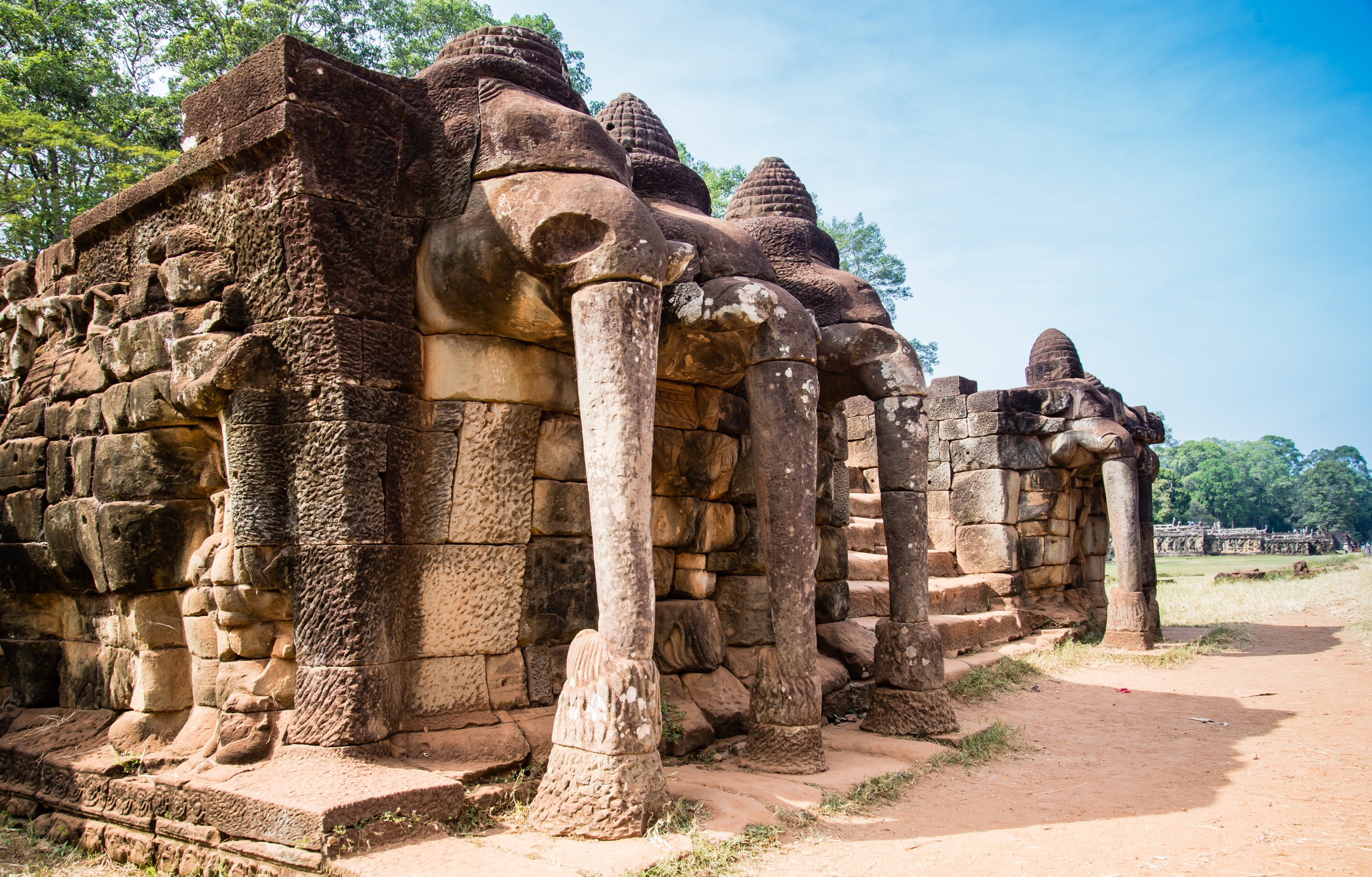
- The Elephant Terrace: a few hundred metres north of Bayon, an ancient royal viewing platform adorned with elephant bas-reliefs.
To extend your journey through Cambodge, you can combine Angkor with very different stages such as the coffee plantations of Mondulkiri in the east, or Kep National Park on the southern coast.
Frequently asked questions
Frequently asked questions
Allow 1.5 to 2.5 hours for a comfortable visit, including reading the bas-reliefs and climbing to the central sanctuary. Enthusiasts of iconography can spend a half-day here.
No, the temple is included in the Angkor Pass, which gives access to the entire Angkor archaeological park. The pass comes in 1, 3 or 7-day formats.
Early morning for slanting light on the face-towers and cool temperatures, or late afternoon for the bas-reliefs. Midday is warmer and more crowded.
The temple originally had 54 towers bearing faces on all four sides. 37 remain today, making over 200 faces still visible, identified by scholars as the bodhisattva Lokeshvara, Brahma or King Jayavarman VII.
Originally it is a Mahayana Buddhist temple built by Jayavarman VII. Under Jayavarman VIII it was converted back to Hinduism, which explains the coexistence of elements from both traditions on the site.
Discover Angkor with Nomadays
Bayon takes on its full meaning when placed within the entire Angkor park and the history of the Khmer empire. To build an itinerary combining the great temples, the Cambodge countryside and the coast, consult our suggestions for trips to Cambodge.
Nearby
Interested in this visit?
We can include it in your personalised itinerary.