Where to photograph Angkor temples at sunrise?
Photographing Angkor at sunrise requires choosing the right spot, arriving early, and waiting it out. Between the Angkor Wat reservoirs, elevated temples, and morning mist, the wait is often worth the early wake-up call.
Planning to visit the temples of Angkor and catch the sunrise? While the phenomenon draws crowds of tourists (even at dawn), it promises a magical moment suspended in time that leaves a lasting impression... Discover our practical guide for photographing Angkor temples at sunrise.
Where to photograph Angkor temples at sunrise?
Cambodian authorities have established visiting hours for all Angkor temples. Most temples in the park can be visited from 7:30 am to 5:30 pm. Only 4 of them are open at dawn, from 5 am onwards:
Angkor Wat,
Sras Srang,
Pre Rup,
Bakheng.
Angkor Wat, the must-see spot for sunrise
This is THE most famous temple of Angkor. And for good reason, Angkor Wat is the world's largest temple and the world's largest religious monument. Built around the early 12th century by Suryavarman II to honor the deity Vishnu, it was later adapted to Buddhism towards the end of the 14th century. Having become Cambodia's symbol, it appears on its national flag and is the country's most visited site.
With its central tower and prasats (lotus towers) soaring over 65 meters high, its ultra-preserved Khmer architecture makes it one of the best places to witness the sunrise.
Where to see the sunrise at Angkor Wat?
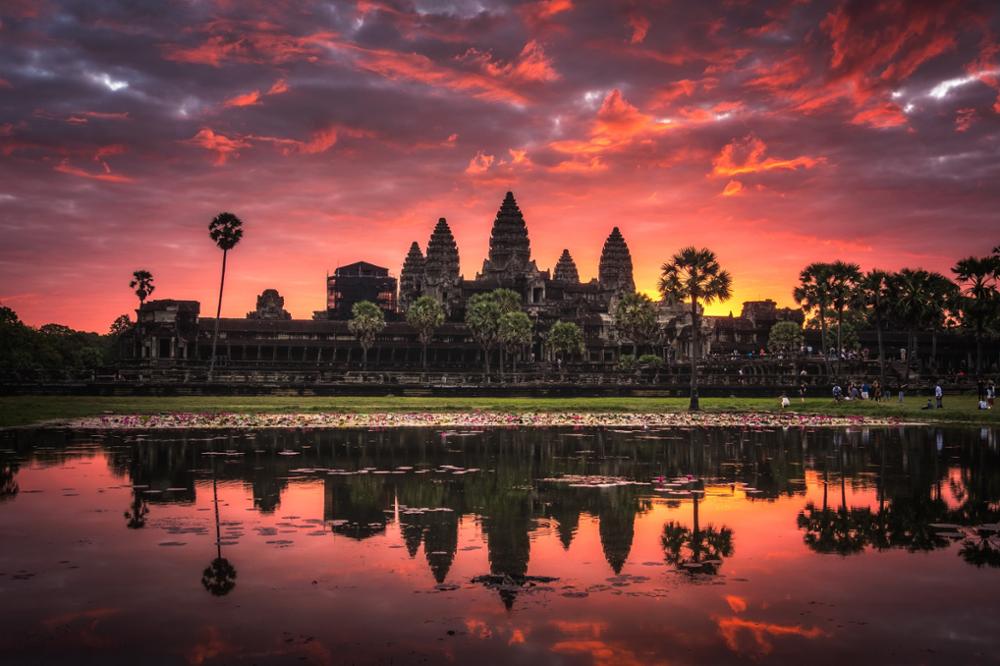
Angkor Wat is, without a doubt, the most sought-after location for watching the sunrise at Angkor. Just search "Angkor sunrise" on Google to see for yourself. The most popular photos are all taken from the same spot: the reservoirs in front of the temple's main entrance. And for good reason—these basins offer all the right conditions for the perfect shot. The temple's silhouette and surrounding landscapes are reflected in the water, creating perfect symmetry. As the sun rises, it passes behind the temple's magnificent towers.
The north reservoir (left basin) is the most popular with photographers. So expect the most crowds here. Why? Because it offers the best angle to capture the temple head-on and in its entirety (with all the towers). It's therefore the spot to choose if you want the perfect photo of Angkor Wat reflected in the water.
Note that for latecomers and those who want to avoid being jostled about, there are other options like the south reservoir (right basin), the library steps, or from the entrance gopura.
Other spots to see sunrise at Angkor while escaping the crowds
Don't want to find yourself in the crowds and being pushed around while photographing the sunrise over Angkor's temples? Head to the 3 other temples on the site that are open at dawn:
Pre Rup
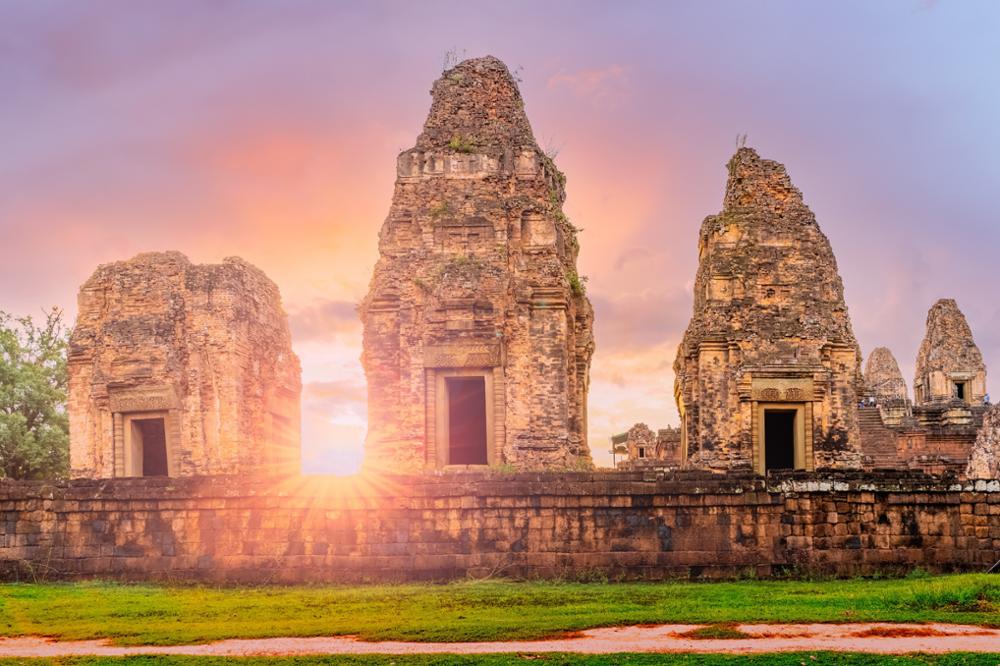
Nicknamed the « Pyramid Temple » the Pre Rup is the state temple of King Rajendravarman II. Built in 961, it is characterized by a 3-level structure with 5 lotus towers. Its name means "change the form" and refers to a funerary rite. It's one of the reasons historians believe it may have served as a crematorium for the royal family.
If it ranks among the best temples at Angkor for watching the sunrise, it's because it offers exceptional views of the surrounding landscape, including the Eastern Baray rice paddies. Moreover, this 1,200-year-old temple was built entirely of brick, laterite, and sandstone, which creates sublime reddish and orange hues when struck by the sun's rays at sunrise (or sunset).
Sras Srang
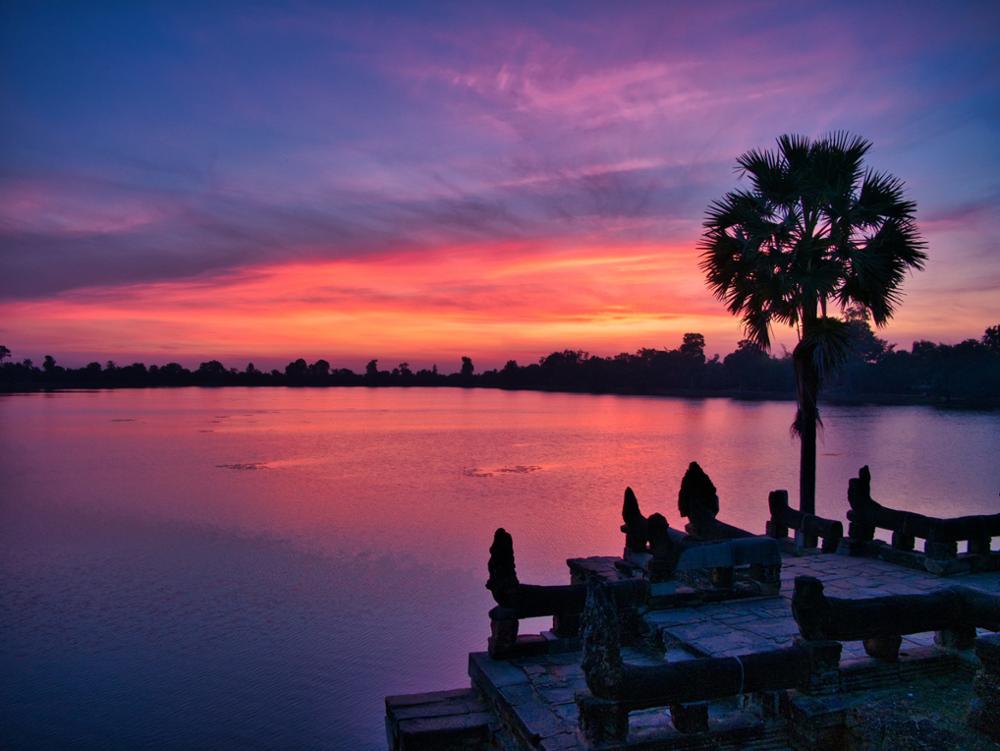
Srah Srang is not a temple but rather a baray (or water reservoir) located just opposite Banteay Kdei temple. Excavated in the mid-10th century by Kavindrarimathana, it was later modified by Jayavarman VII in 1200. Used as a royal bath, inscriptions found at the site dating from the mid-10th century suggest it was also used to provide water « for the benefit of all creatures ».
Less frequented than most Angkor sites, it offers a peaceful alternative to the crowds at Angkor Wat for watching the sunrise. The best spot to view the sunrise from Srah Srang is at the western end of the site where you'll find a multi-level terrace adorned with Khmer sculptures.
Phnom Bakheng
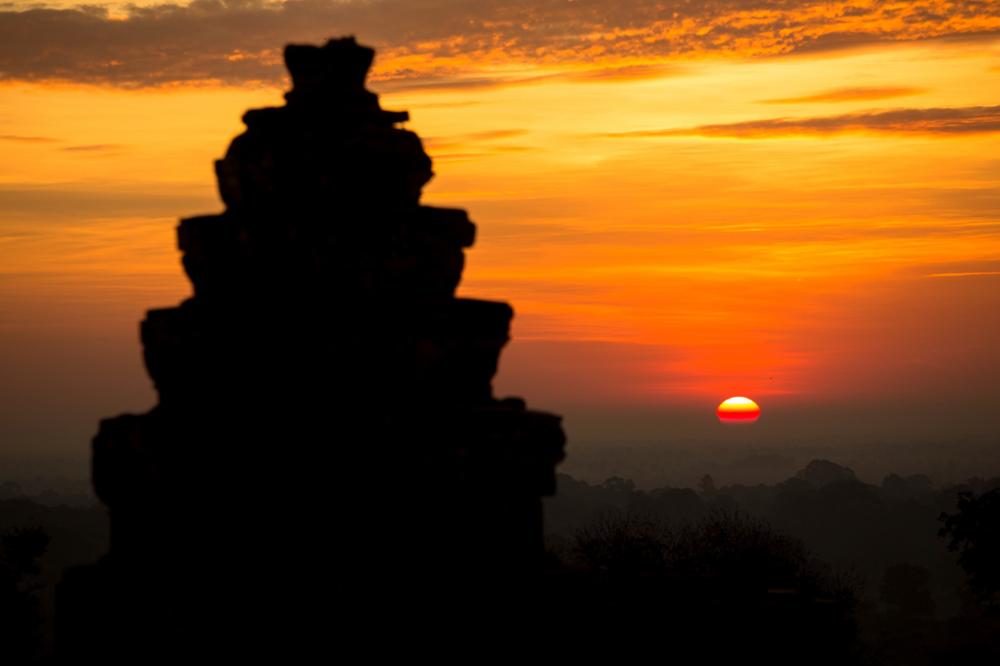
Built around 900 during the reign of King Yasovarman, Phnom Bakheng is the first temple built on the Angkor site itself. Constructed on a hill to honor Shiva and the god-king, it is the prototype of Khmer temple mountains. It is characterized by a five-tiered pyramid shape punctuated with 109 towers.
Due to its height, Phnom Bakheng is a popular site for viewing sunrise and sunset. Climbing to the top of the temple, you will enjoy a breathtaking view of the surrounding jungle. At sunrise, you'll be mesmerized by sunbeams piercing the treetops, all enhanced by the mystical atmosphere created by morning mist. Beyond the lush vegetation, you can also see the famous Angkor Wat temple.
Warning
The temple allows only 300 visitors at a time. So it's best to arrive early to be one of them!
When to see the sunrise over Angkor temples?
In Cambodia, sunrise and sunset times don't vary much throughout the year. Generally speaking, the sun rises:
Around 6:30 am from January to April;
Around 5:30 am from May to July;
Around 6 am from August to December.
As you might expect, you won't be alone in admiring the sunrise over Angkor's temples. Every day, hundreds, even thousands of people come at dawn to enjoy the spectacle. That's why arriving early is to your advantage. We recommend buying your entrance tickets the day before your visit so you don't have to queue on the day itself.
Since the Angkor site opens at 5 am, we recommend being there at opening time to be among the first to enter the site and maximize your chances of securing a good spot.
Good to know
It's cold at this hour, so bring something to cover yourself while waiting for sunrise.
Don't rush and wait for the sun to truly rise!
Whatever spot you've chosen, don't make the mistake of leaving too early. Many visitors actually leave before even seeing the sun come up. And while the spectacle is at its peak when the sky takes on soft, warm colors, the sun's appearance on the horizon (between the trees or temple towers) is a sight not to be missed in itself!
What is the Angkor Equinox?
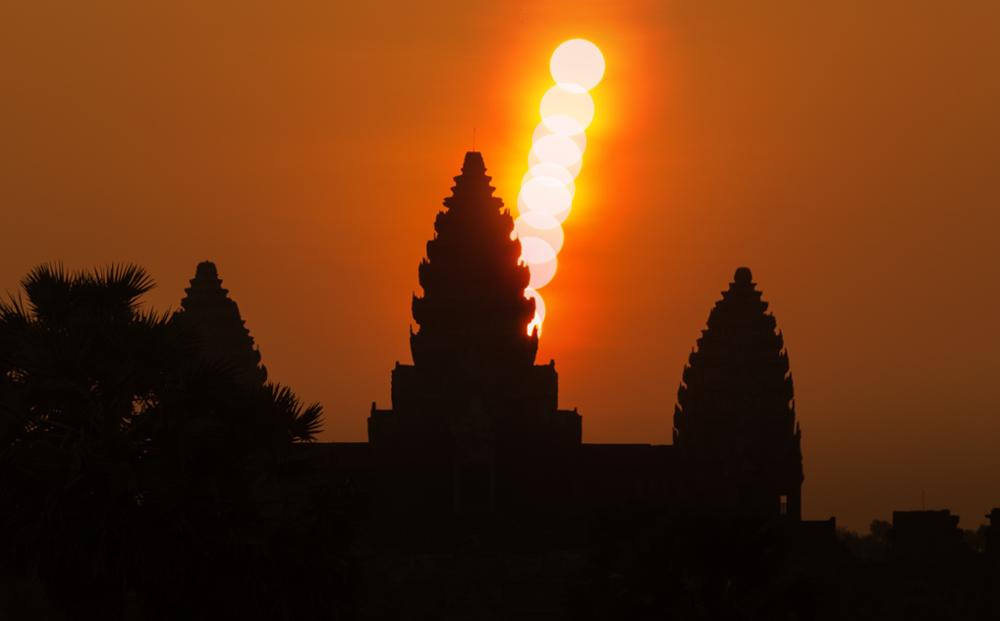
The Angkor Equinox is one of the most anticipated events for photographers traveling to Cambodia. It refers to the moment when the sun rises directly over the summit of Angkor Wat's central tower, creating perfect alignment. This phenomenon once again demonstrates the architectural prowess and astronomical knowledge of the Khmer empire.
The Angkor Equinox occurs only 2 times a year: during the spring equinox (late March) and the autumn equinox (late September). The Apsara National Authority announces the official dates each year. To find out the dates of the Angkor Equinox 2024, we recommend keeping an eye on the events listed on their official website: apsaraauthority.gov.kh.
Don't have much time to organize your Angkor temple visit? We recommend traveling with an English-speaking guide so you don't have to rush and can benefit from the best viewpoints to get the photo of your dreams. Feel free to contact us to take advantage of our local guides' services!
Frequently asked questions
4 Angkor temples open at 5 am: Angkor Wat, Sras Srang, Pre Rup, and Phnom Bakheng. Other temples only open at 7:30 am.
The north reservoir in front of Angkor Wat offers the best angle to capture the temple with its reflection. To avoid crowds, Pre Rup and Sras Srang are excellent alternatives.
The Angkor Equinox is a phenomenon where the sun rises directly over Angkor Wat's central tower. It occurs twice a year: late March and late September.
It is recommended to purchase entrance tickets the day before to avoid queuing. Phnom Bakheng limits access to 300 simultaneous visitors.