War Remnants Museum
War Remnants Museum
In Ho Chi Minh City, the War Remnants Museum documents the Vietnamese conflict and its aftermath through photographs, archives and military equipment.
The War Remnants Museum, located in District 3 of Ho Chi Minh City, documents the conflict that opposed Vietnam against French and then American forces, as well as its human and environmental consequences. Housed in a building that once served as the American Information Services (USIS), it brings together photographs, archives and military equipment. It is one of the most visited museums in the country, by both foreign travelers and Vietnamese alike.
Why visit the War Remnants Museum
The visit sheds light on a central chapter of Vietnam's contemporary history. The museum draws on an extensive collection of photographs, mostly from American sources, taken by photojournalists during the war. This visual documentation captures both the daily reality of combat, the media coverage of the conflict and its civilian repercussions, particularly those related to massive Agent Orange spraying.
The exhibition is dense and the displays are explicit. The visit is thought-provoking but it provides essential context for understanding modern-day Vietnam, which you can extend to the nearby Reunification Palace.
Museum history
The museum was created in 1975, shortly after the fall of Saigon, under a name highlighting American atrocities. It was renamed the "War Remnants Museum" in 1995, during the restoration of diplomatic relations between Vietnam and the United States. This evolution was accompanied by an editorial repositioning: the narrative remains centered on the Vietnamese perspective, but the iconography has expanded to include international photographic archives.
The building itself is part of the history it tells. Before 1975, it housed the United States Information Service (USIS), the institution responsible for American cultural and communication programs in South Vietnam.
What to see at the museum
The outdoor courtyard
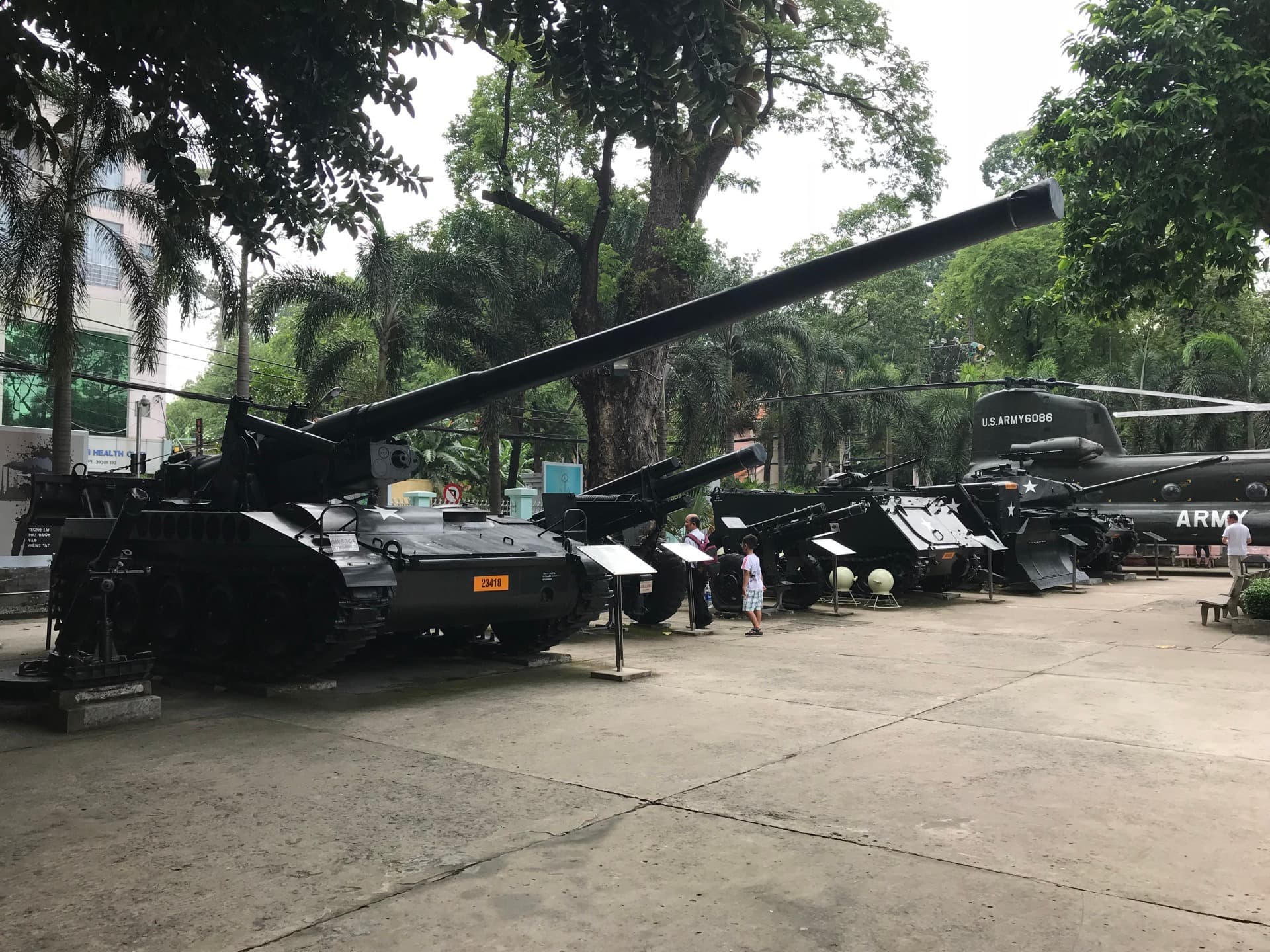
The entrance opens onto a courtyard where several American armored vehicles, artillery pieces, bombs and a sampling of infantry weapons are on display. Helicopters, tanks and fighter jets underscore the scale of the military resources deployed.
The photography halls
The main floor is devoted to war photojournalism. The prints, largely from American news agencies and reporters, cover military operations, civilian life and the most controversial episodes of the conflict, including the 1968 My Lai massacre. One room is dedicated to photographers who died at the front, both Vietnamese and foreign.
Agent Orange and its aftermath
An entire section documents the massive Agent Orange spraying and the resulting consequences: lasting soil pollution, congenital malformations and diseases passed down through several generations. The photographs here are direct and the experience can be difficult.
Prisons and the reconstruction of "tiger cages"
Part of the tour reconstructs detention conditions in South Vietnamese prisons, particularly those on Con Dao Island. The visit here is shorter but striking.
Practical information
- Duration of visit: allow 1.5 to 2 hours to tour all the halls.
- Admission: modest entrance fee, payable in dong on site.
- Hours: open daily during daytime; check current opening times before your visit.
- Audioguide: available in several languages, including English-speaking and French.
- Audience: visit not recommended for young children due to the intensity of the images.
- Photography: permitted in most halls, without flash.
How to get there
The museum is located at 28 Vo Van Tan Street, in District 3, about 15 minutes' walk from the Reunification Palace and the center of District 1. From Ben Thanh Market, allow about twenty minutes on foot or a short taxi ride. Local ride-hailing apps (Grab, Be) serve the entire area and remain the simplest option. Several bus lines also serve the areas around the Reunification Palace, a few streets from the museum.
Nearby
The neighborhood concentrates several major sites in Ho Chi Minh City, ideal for a combined day visit:
- The Reunification Palace a 5-minute walk away, the former seat of the South Vietnamese government.
- Notre-Dame Cathedral of Saigon, a red brick building constructed in the late nineteenth century.
- The Central Post Office, attributed to Gustave Eiffel's circle, next to the cathedral.
- Dong Khoi Street, the commercial axis that runs down to the Saigon River.
To extend your discovery of Vietnam beyond the city, you can combine this visit with Cai Rang floating market in the Mekong Delta, or with Buu Long Mountain on the outskirts.
Frequently asked questions
Frequently asked questions
Allow 1.5 to 2 hours to tour all the halls and the outdoor courtyard. A quicker one-hour visit is possible if you focus on the main sections.
Several sections, particularly those devoted to Agent Orange and war photojournalism, feature very powerful images. The visit is not recommended for children under adolescence.
Yes, an audioguide is available in several languages including English-speaking. The labels are written in Vietnamese and English.
The museum presents the conflict from the Vietnamese perspective and emphasizes the consequences suffered by civilian populations. This lens, which you should be aware of before your visit, does nothing to diminish the documentary value of the photographs on display, a large portion of which comes from American archives.
Yes. The Reunification Palace, Notre-Dame Cathedral and the Central Post Office are all within a few minutes' walk. All can be comfortably visited over half a day.
Include the museum in your trip
The War Remnants Museum is part of any first visit to Ho Chi Minh City and provides useful context for the rest of your journey, whether continuing to the Cu Chi Tunnels, the Mekong Delta or central Vietnam. To build a custom itinerary, consult our Vietnam trips.
Interested in this visit?
We can include it in your personalised itinerary.