Phnom Da
Phnom Da
Phnom Da, a 6th-century hilltop sanctuary in Takeo province, shelters among Cambodia's oldest Khmer temples and dominates the rice plains of Angkor Borei.
The archaeological site of Phnom Da rises south of Phnom Penh, in Takeo province, considered the cradle of Khmer civilization. This isolated hill overlooks the rice plains of Prek Ta Phor village, a few kilometers from the ancient capital of Angkor Borei. It shelters a cluster of 6th-century temples among Cambodia's oldest, bearing witness to the pre-Angkorian culture of Funan.
Why visit Phnom Da
Phnom Da was the principal religious and cultural center of Angkor Borei, the final capital of Funan. The site lent its name to pre-Angkorian statuary known as the "Phnom Da style," regarded as the earliest form of Khmer sculpture. Listed on UNESCO's Indicative List of World Cultural Heritage, the ensemble comprises a laterite prasat, a basalt stone sanctuary, and five cave-sanctuaries carved into the hillside. The panorama over the rice plains, transformed into a lake during the rainy season, adds to the site's appeal.
History
The temples of Phnom Da date from the 6th century, when Angkor Borei flourished as capital of the Norkor Phnom kingdom (Funan). The site provided Cambodian archaeology with a significant portion of its stylistic benchmarks: statuary of Vishnu, Harihara, and other Hindu deities that defined the "Phnom Da style." Phnom Da was added to UNESCO's Indicative List of World Cultural Heritage on September 1, 1992, as part of the Angkor Borei dossier encompassing its temples.
The site's recent history is darker: under the Khmer Rouge regime (1975-1979), the caves are said to have been used as cremation sites, according to local oral traditions.
What to see on site
The Prasat Phnom Da
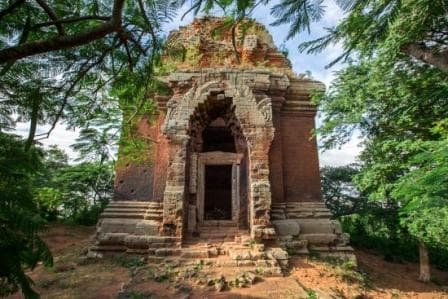
This square tower was built in the 6th century under King Rutravarman, during the Norkor Phnom period. It measures roughly 12 m² at ground level and stands 18 meters high. Its entrance door opens to the north, facing the ancient capital of Angkor Borei; the three other sides bear false doors topped with sculptured lintels. Inside, a Linga (representation of Shiva) rests upon a Yoni (female base symbolizing fertility). The ritual consists of pouring water over the Linga: collected in the Yoni, it was once drunk by warriors to absorb the power of the gods. Even today, couples desiring children come to pray here, believing this water grants fertility.
The Asrom Moha Eysei
Some 300 meters southwest of the main prasat, this small sanctuary, also called Prasat Neang Peou, was erected in the late 6th century under King Pavavarman I. Its architecture recalls temples of South India, featuring five windows and two doors. Its grey color stems from the basalt stone used in its construction, a material rarely employed in Khmer architecture.
The five artificial caves
Hand-carved into the hillside, these five cavities served as sanctuaries and each harbors a Linga and a Yoni. According to local memory, they are believed to have been used by the Khmer Rouge as cremation sites between 1975 and 1979.
The Angkor Borei Museum
Part of the artifacts discovered on site is preserved at the Angkor Borei Museum, located 5 km from Phnom Da. Visiting both places is complementary to understanding pre-Angkorian civilization.
Practical information
Ascending the hill is done via a long staircase of roughly a thousand steps. Wear sturdy shoes, bring water, and plan for sun protection: the climb is exposed. The site is open from dawn to dusk. Visiting time ranges from 1.5 to 3 hours depending on whether you combine the main prasat, the Asrom Moha Eysei, and the caves. A modest entrance fee is typically required.
When to visit
The site can be visited year-round, but the landscape changes dramatically by season. During the rainy season (June-October), the plains are flooded and the hill emerges amid an immense lake. During the dry season (November-May), lush rice paddies stretch to the horizon. The dry season is most practical for road access; the wet season offers a more spectacular setting but requires a boat.
How to get there
Phnom Da is located in Takeo province, accessible from Phnom Penh in roughly half a day.
- During dry season: access by road from Daun Kaev, the provincial capital. You can take a bus heading to Phnom Chisor, then a local taxi to Phnom Da. The road crosses rural landscape dotted with traditional Khmer houses.
- During rainy season: access is by boat only from Daun Kaev, via Angkor Borei, with water completely encircling the hill.
What to see nearby
- Angkor Borei and its museum – 5 km away, the former Funan capital beautifully complements a visit to Phnom Da.
- Phnom Chisor – an 11th-century temple perched on a hill, on the route between Phnom Penh and Takeo.
- Choeung Ek – Killing Fields memorial, near Phnom Penh.
- Nokor Bachey – temple complex near Kampong Cham.
- Bakong and Angkor Thom – to extend archaeological exploration toward Siem Reap.
Frequently asked questions
Frequently asked questions
Planning your trip
Phnom Da fits naturally into an itinerary in southern Cambodge, between Phnom Penh and the Vietnamese border. To design a custom journey incorporating this archaeological stop, consult our Cambodge travel suggestions.
Interested in this visit?
We can include it in your personalised itinerary.