The History of the Kings of Angkor
Before Angkorian civilization spread across the region, Southeast Asia functioned more as a commercial crossroads stretching from the Mediterranean to China. Indian and Chinese merchants began arriving in greater numbers, exposing indigenous peoples to their cultures, though it was Indian culture that took root.
Before Angkorian civilization spread across the region, Southeast Asia functioned more as a commercial crossroads stretching from the Mediterranean to China. Indian and Chinese merchants began arriving in greater numbers, exposing indigenous peoples to their cultures, though it was Indian culture that took root!
Indian culture, religion (Hinduism and Buddhism), law, political theory, science and writing spread throughout the region over several centuries and were progressively adopted by existing states.
Pre-Angkor: Funan and Chenla
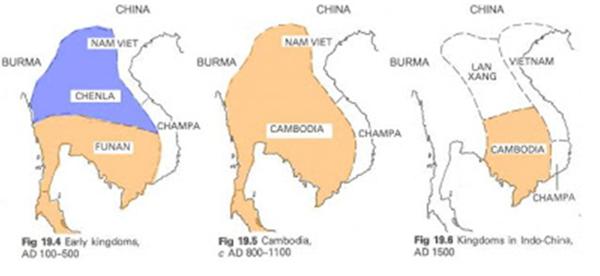
During the pre-Angkor period, Cambodge was composed of numerous princely states, often limited to a fortified city, which fought amongst themselves to expand their territories. Two powers dominated the region: the Indian state of Funan, centered in southern Vietnam and Cambodge, and the state of Chenla in northern Cambodge.
From the 6th century onwards, as Funan began to decline, Chenla and the Mon people conquered Funan's territory, marking the beginning of the pre-Angkorian period!
The third and final king of a unified Chenla, Isanavarman I, built the pre-Angkorian temples of Sambor Prei Kuk near the modern city of Kampong Thom.
In fact, if you travel to Siem Reap from Phnom Penh by road, you will pass through Kampong Thom where it is possible to make a detour to these pre-Angkorian ruins.
Under Isanavarman I's successor, Chenla disintegrated into small warring states. It was briefly reunited under Jayavarman I in the mid-7th century, only to collapse again after his death. According to traditional accounts, Chenla eventually split into two states or rival alliances, "Land Chenla" in northern Cambodge and southern Laos, and "Water Chenla" centered further south at Kampong Thom.
The Beginning of the Angkorian Era
Jayavarman II, a former Khmer prince and warrior, is the first king of the Angkorian era. Around 790, after a long stay at the royal court of Java, he returned to Cambodge to unify the states. After numerous battles and alliances, in 802, he declared a sovereign and unified "Kambuja" under a single ruler. He legitimized his "universal kingship" by establishing a royal cult, the cult of the god-king during his declaration on Kulen Mountain north of Siem Reap. From then on, the king became the representation of Shiva, the supreme god of the Brahmanist trinity (Brahma, Shiva, Vishnu) and thus had to be worshipped as a deity.
Subsequently, Jayavarman II continued to pacify rebellious areas and expand his kingdom. He established himself at Roluos, which became the first capital and which he named Hariharalaya in honor of the combined god of Shiva and Vishnu. He ruled at Hariharalaya until his death in 850.
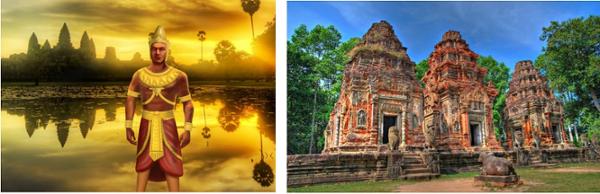
Thirty years after his death, King Indravarman III built the temple of Preah Ko, the first major monument of the "Roluos Group", in honor of Jayavarman II.
He also constructed the first great Baray, a water reservoir. Thus the defining marks of Angkorian royalty were established: in addition to the king's cult, the construction of temples and large-scale water projects became a royal tradition.
Indravarman III's son, Yasovarman I, perpetuated his father's tradition by building the Eastern Baray and the last major temple, Lolei, of the "Roluos Group" and the first great temple of the Angkor region, Phnom Bakheng. Following a violent confrontation with his brother for the throne, he abandoned the royal palace at Roluos in ruins and moved his capital, in 893, to the new Yasodharapura at Angkor. With one exception, the capital would remain in the Angkor region for the next 500 years.
The Height of the Khmer Empire
An era of territorial, political and commercial expansion followed the return to Angkor. The royal court built several important monuments including Ta Keo, Banteay Srey, Baphuon, and the Western Baray. The kings of the time exercised their military might; King Rajendravarman for example led successful campaigns against the eastern enemy Champa in the mid-10th century.
After nine years of political turmoil, King Suryavarman I took control of the kingdom in 1010. He led the Khmers to numerous important military victories, notably the conquest of the Mon Empire to the west, capturing much of modern-day Thailand and bringing the entire western portion of ancient Funan under Khmer control. A century later, King Suryavarman II led several successful campaigns against the traditional eastern enemy of the Khmers, Champa, in central and southern Vietnam.
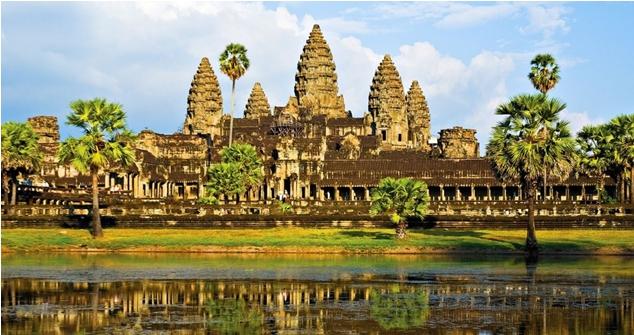
In the early 12th century, under Suryavarman II, the empire was at its political and territorial peak. At its height, Suryavarman II realized Angkor's most spectacular architectural monument, Angkor Wat, as well as other monuments such as Thommanon, Banteay Samre and Beng Melea.
Angkor Wat was built as Suryavarman II's state temple and perhaps as his funerary temple. In fact, vast battle scenes from his campaigns against Champa are recorded in the magnificent bas-reliefs on the southern wall of Angkor Wat.
Toward the end of the 12th century, following internal conflicts, rebellious states in the provinces and unsuccessful campaigns against the Vietnamese, the empire began to weaken. In 1165, during a turbulent period when Khmer and Cham princes plotted and fought together and against each other, a usurper named Tribhuvanadityavarman seized power at Angkor.
In 1177 the usurper was killed in one of the worst defeats suffered by the Khmers at the hands of the Chams. Champa, allied with certain Khmer factions, launched a naval attack on Angkor followed by a land attack. The city was then attacked, burned and occupied by the Cham people.
Jayavarman VII: The Legendary
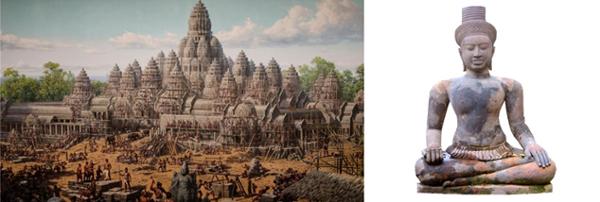
The Chams controlled Angkor for four years until the legendary Jayavarman VII launched a series of counter-attacks over several years. After the Cham defeat in 1181, Jayavarman VII was declared king. Breaking with nearly 400 years of tradition, he made Mahayana Buddhism the state religion and launched major projects to build Angkor's monuments.
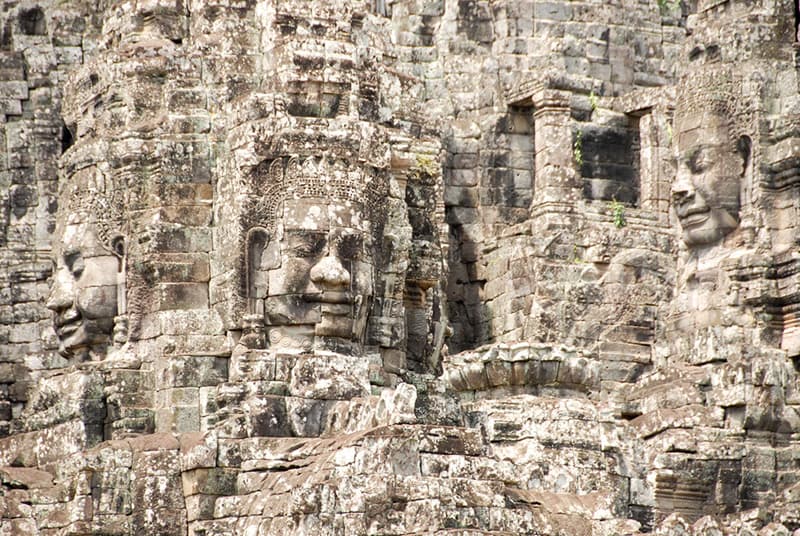
Jayavarman VII's building campaign took place at a frenetic pace! Hundreds of monuments were built in less than 40 years. Jayavarman VII's works include the famous stone faces of Bayon, his capital Angkor Thom, the temples of Ta Prohm, Banteay Kdei and Preah Khan, and hundreds of others. Jayavarman VII also waged aggressive military campaigns against Champa. In 1190, he captured the Cham king and brought him to Angkor. He annexed all of Champa, thereby expanding the Khmer empire as far as southern Vietnam.
Jayavarman VII's prodigious building campaign also represents the end of the Khmer empire as no other major monument was built after his death in 1220. His successor, Indravarman II, continued the construction of some of Jayavarman VII's monuments with limited success.
The End of an Era
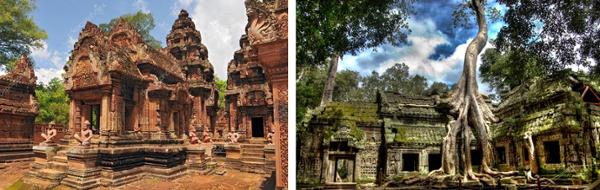
Although monument construction ceased, the capital remained highly active for many years. Hinduism made a comeback under Jayavarman VIII in the late 13th century, during which most of Angkor's Buddhist monuments were systematically defaced. Thousands of Buddha images were removed, some Buddha images were crudely converted into Hindu lingas and bodhisattvas. In fact, you can see examples of this at the temples of Ta Prohm and Preah Khan.
Jayavarman VIII also built the final Brahmanist monument at Angkor, the small East Prasat Top tower at Angkor Thom. After Jayavarman VIII's death, Buddhism returned to Cambodge but in a different form. Instead of Mahayana Buddhism, Theravada Buddhism took root and remains the dominant religion in Cambodge to this day.
Afterwards, Angkor suffered repeated invasions by the Thai from the west. After a 14-month siege of Angkor in 1431, King Ponhea Yat moved the capital from Angkor to Phnom Penh in 1432, notably to facilitate commercial exchanges due to proximity to the Mekong. After this move, the capital of Cambodge relocated several times, first to Lovek then to Oudong, before finally settling in Phnom Penh in 1866.
While the history of Khmer civilization extends beyond the Angkorian period alone and Angkor does not by itself encompass the richness, diversity and grandeur of Khmer art, it was these that fascinated Westerners when they discovered in 1860 the mysterious capital buried beneath vegetation. The book by Henri Mouhot "Travels in Siam, Cambodge, Laos and Annam" greatly contributed to the renown of this part of the world and to the influx of the first tourists.