Eco-tourism Powered on the Banks of Tonlé Sap
Founded by two self-taught Cambodian brothers, Komnob Airboat Tours invites travelers to experience Tonlé Sap in a new way, blending local innovation, nature and lacustrine villages.
29 Jan. 2019Som Samnorp and his younger brother Som Samnang decided in 2012 to become the first Cambodians to launch an airboat with the goal of showcasing their country to tourists. After three years of self-directed study, these two self-taught mechanical engineers from the village of Arey Ksat near Phnom Penh, successfully launched their first propeller-driven vessel. An ecological and exhilarating way for travelers to discover Tonlé Sap Lake at any time of year.
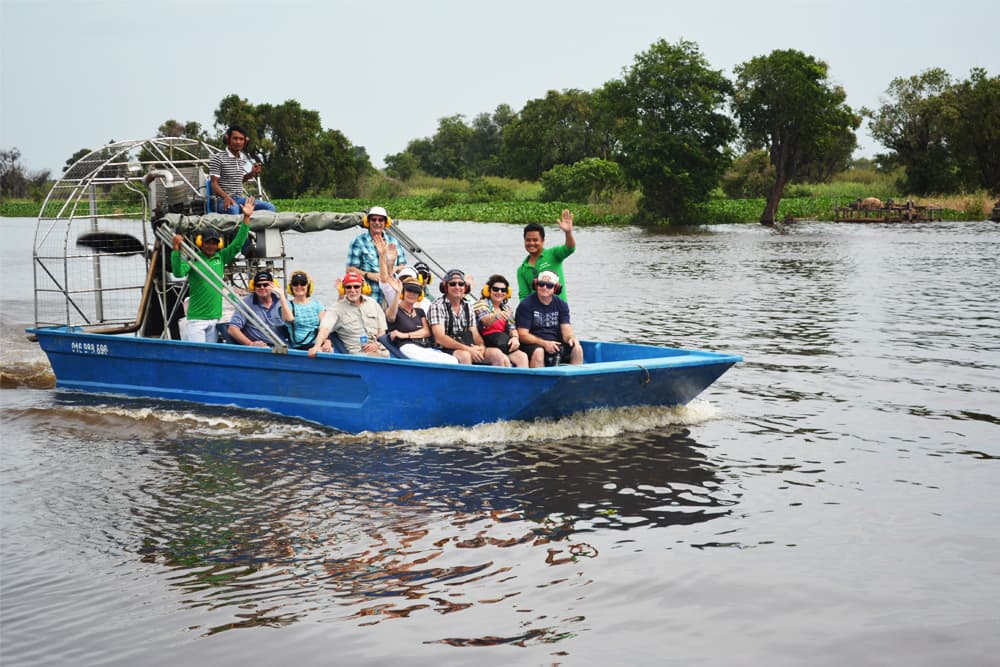
Shortly after creating their first prototype, the two pioneers established Komnob Airboat Tours, an agency offering five distinct circuits across Tonlé Sap Lake and its surroundings aboard their airboats. Prices range from $35 to $130 per person ($20 to $80 for children), depending on the tour selected. These include the Silver and Gold Group Tours, which offer 50 and 70-kilometer journeys across the lake alongside other guests. The Platinum and Diamond Private Tours allow families or friends to explore exclusively for 4 hours, navigating the hidden corners of Southeast Asia's largest lake. Finally, the Sanctuary Birds Group Tour provides a 6.5-hour immersion into local villages while learning about the wildlife and flora inhabiting this vast expanse of water. Hotel pickup and drop-off, along with an English-speaking guide, are included in all circuits. Meals are provided starting from the Gold Group Tour.
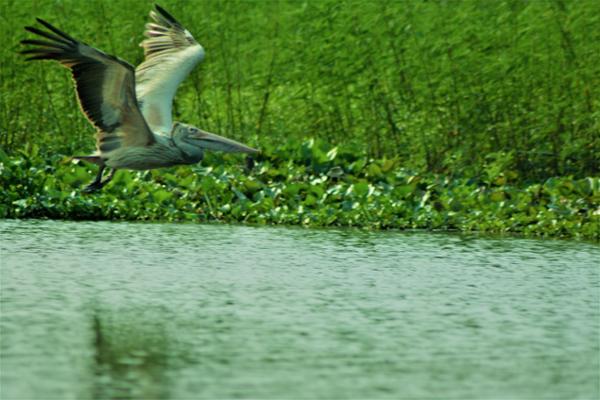
Photo taken during the Sanctuary Bird Tour. ©Komnob Airboat Tours website.
An Original Alternative to the Region's Dominant Tourist Activity
The airboat glides across the water on a cushion of air—or other delicate structures—requiring no submerged propeller to advance. Instead, a massive rear-mounted fan propels it directly, allowing it to navigate shallow marshlands where conventional boats cannot venture due to minimal water depth. "This transport tool is very useful. It can carry people across different terrains, particularly in shallow waters and grassy areas. Where there are no roads, the airboat finds its own path," Samnang told the Phnom Penh Post. Beyond this advantage, Samnang, a mechanical engineer for over 15 years, affirms that the airboat is a genuine eco-tourism option. Its hybrid engine, designed to rapidly spin the fan, consumes less energy than traditional boats crossing Tonlé Sap. Of course, this comes at a cost. The two brothers use fiberglass and carbon fiber for the vessel's hull, ensuring long-term durability while maintaining the lightness essential for air propulsion. "I built it using parts from a car engine, but I had to order the giant fan from abroad," explains younger brother Samnang. "We needed a capacity of at least 150 cc (cubic centimeters) for our smallest airboat. We spent a lot of money because most equipment and spare parts aren't available in our country, like the fan and fiberglass." The smallest vessel cost $10,000 total. The engineers operate three of them—this model accommodates six passengers compared to 25 for the largest.

Samnorp and his brother Samnang, accompanied by that day's tourists. ©Komnob Airboat Tours website.
A Portion for Education
For the past four years, Samnorp and Samnang's vessels have glided across Tonlé Sap Lake's surface at speeds exceeding 100 km/h. They are, of course, not alone in benefiting from this majestic natural reserve, coupled with the indescribable charm of daily life in the floating villages. They understand how central these communities are to the abundant tourist activities offered on the lake. That's why, in their own philanthropic way, they dedicate a portion of each ticket's proceeds to education for children in Kompong Pluk, Kompong Kleang, Chong Kneas and other villages in the region. Though themselves hailing from Phnom Penh's suburbs, they supply books and school materials to these communities.
Thibault Bourru
Thibault BourruA passionate enthusiast of literature and Asia, Thibault shares his experiences through his writing.