Prasat Banon
Prasat Banon
An 11th-century Khmer mountain temple perched at 400 meters elevation near Battambang, Prasat Banon blends Angkorian architecture, local legend and views over the plains.
Prasat Banon is a Khmer mountain temple perched at 400 meters elevation, approximately 20 km south of Battambang, in Kantueu Pir commune, near the Sangkaé River. Built in the 11th century, it stands as an architectural testament predating Angkor Wat and offers sweeping views over the rice plains of northwestern Cambodge.
Why visit Prasat Banon
The site combines three compelling interests: a sandstone and brick temple from the 11th-12th century still legible despite deterioration, an athletic climb of 358 steps that introduces you to Battambang's landscape, and strong local significance as Khmer families come to picnic here on weekends. It's one of the rare Angkorian temples accessible without traveling through Siem Reap, making it a worthwhile stop during a Battambang stay.
History of the temple
Construction of Prasat Banon began in 1057 under the reign of Udayādityavarman II and was completed in the 12th century under Jayavarman VII, builder of the Bayon temple. The sanctuary follows the same architectural tradition, with an organization of tower-sanctuaries and carved bas-reliefs.
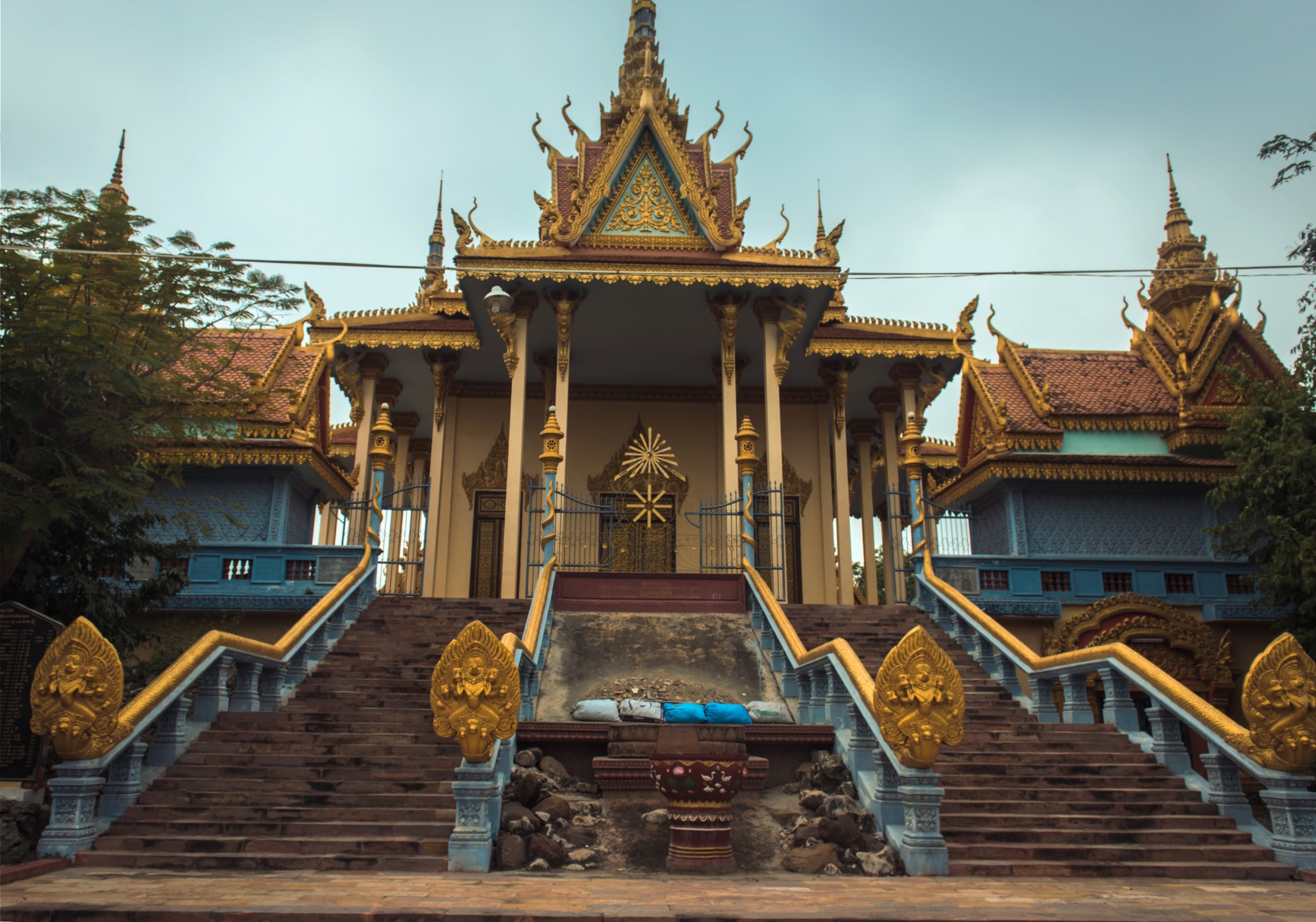
At the base of the hill, two pagodas historically frame the site: Vat Banon Leu, upstream, still active; and Vat Banon Krom, downstream, now razed — only the entrance gate and some kod remains survive. The place name Banon is said to derive from Lear Bomnon, an expression meaning "to give thanks for something requested through prayer".
The legend of Nén Roong
Oral tradition tells of a royal wife who gave birth to an egg, cast into the sea and later recovered by a couple who raised the child as Nén Roong. After studying in a neighboring (Siamese) kingdom, he gained the power to turn the living into stone. The Cambodian king sent a general to bring him back. Before leaving, the general prayed at Banon temple, then followed a cave to tunnel his path and emerged abruptly before Nén Roong. Frightened, the latter petrified him. His soldiers returned without him, the statue being too heavy to move. The cave of Kouhéa Preah Toeuk, south of the temple, is said to be this passage.
The word banon means "men" and is translated in local tradition as "warriors": Prasat Banon is thus understood as the "temple of warriors", a place where the king came to pay tribute to the gods after his victories.
What to see on site
Sanctuary architecture
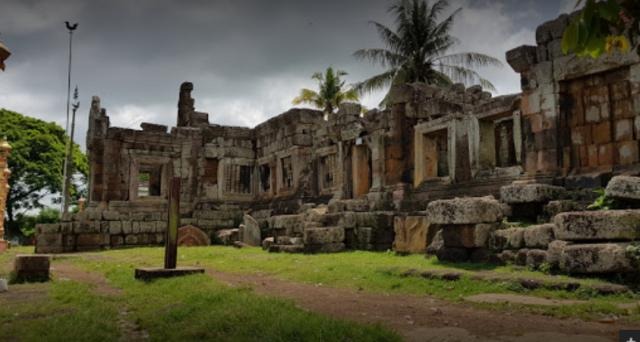
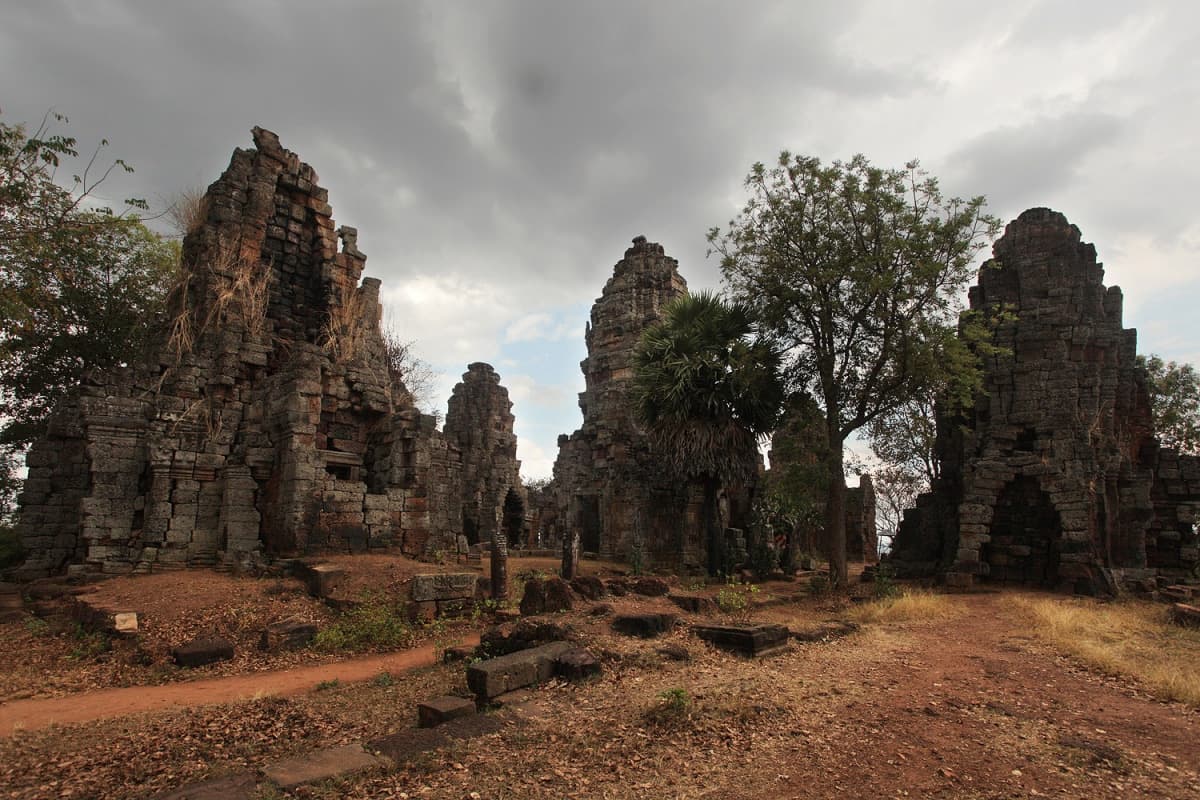
At the summit, four towers remain — three in brick and one in sandstone — arranged along the four cardinal points and linked by galleries. The central sanctuary rises five stories in sandstone and preserves sculptures, ornate portals and bas-reliefs on the central tower. Inside, several Buddha statues attest to the site's still-active religious function.
Statues and notable elements
- Stone lions with naga heads, on the temple terrace; some original pieces are preserved in the Battambang museum.
- Statue of Tép, an elderly woman cooking, located behind the temple.
- Abandoned baray measuring 100 x 200 meters, the temple's former water reservoir, visible at the base of the hill.
- Natural wells Bit Meas and Chhung Achey, immediately near the base of the mountain.
The staircase of 358 steps
Access to the summit is by a steep staircase of 358 steps. The climb requires good physical fitness, especially during the hot season; bring water and avoid peak sunlight hours.
The cave of Kouhéa Preah Toeuk
500 meters south of the temple, through orange groves, lies the sacred cave Kouhéa Preah Toeuk. The main entrance is very low and you must crouch to enter the first gallery. An alternative descent exists from the summit via a rock causeway, but it requires climbing ability. The main chamber, naturally lit, leads to other galleries toward the west.
The view from the terrace
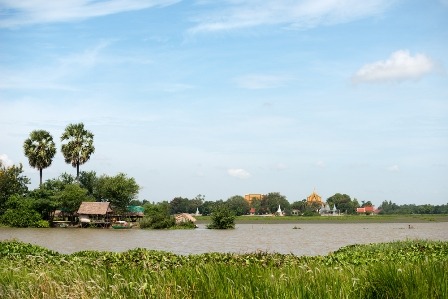
From the sanctuary terrace, your gaze sweeps over the Battambang plains, the Sangkaé River lined with palm sugar trees, and — on clear days — the silhouette of Phnom Sampeou, whose shape evokes a crocodile. The site remains frequently visited by Khmer families who come to picnic on weekends.
Practical information
- Duration of visit: allow 2 to 3 hours on site, including the climb up and descent, plus 30 minutes if you include the cave.
- Fee: a modest entrance fee is requested from foreign visitors (inquire on site, as the amount varies).
- What to bring: water, hat, closed-toe shoes for the steps and cave, clothing covering shoulders and knees out of respect for the sacred nature of the place.
- Level: good physical fitness recommended for the staircase.
When to visit
The dry season, from November to March, offers the best conditions: comfortable temperatures for the climb, clear skies, sharp views of the plains. From April to May, heat makes the ascent grueling. The rainy season (June to October) floods the basins at the foot of the temple and verdifies the surrounding rice fields — an interesting photographic setting, but the staircase can be slippery. Favor early morning or late afternoon for light and coolness.
How to get there
Prasat Banon is reached from Battambang, itself accessible by bus, taxi or boat from Battambang and nearby towns like Siem Reap. From central Battambang, the simplest solution is to rent a tuk-tuk for the day: the journey takes about 45 minutes on partially unpaved road. Your driver will wait at the base of the hill during your visit. Cycling is also possible for fit travelers, as the road is relatively flat.
Nearby
- Battambang: colonial town, art workshops, bamboo train and central market.
- Phnom Sampeou: another nearby mountain temple, famous for its caves and the daily bat exodus.
- Wat Ek Phnom: ruined Angkorian temple north of Battambang, a natural complement to visiting Banon.
Frequently asked questions
Frequently asked questions
Allow 2 to 3 hours on site, including the climb up 358 steps, a visit to the sanctuary and the descent. Add about 30 minutes if you wish to explore the cave of Kouhéa Preah Toeuk.
The staircase has 358 steep steps without continuous shade. Reasonable physical fitness is necessary, and it's best to avoid the hottest hours of the day.
Yes, for two reasons: its architecture predates Angkor Wat and illustrates a different stage of Khmer art, and the experience is radically more peaceful, free of crowds, with strong local character.
Yes, a day by tuk-tuk from Battambang allows you to chain together Prasat Banon, Phnom Sampeou and Wat Ek Phnom, with the bamboo train as an optional addition.
Yes. The sanctuary houses Buddha statues still venerated, and nearby pagodas (notably Vat Banon Leu) remain active. Respectful dress is expected.
Planning your trip
Prasat Banon fits naturally into an itinerary around Battambang and northwestern Cambodge. To build a complete itinerary including temples, rural landscapes and major cities, consult our bespoke Cambodge journeys.
Interested in this visit?
We can include it in your personalised itinerary.