Ba Chuc
Ba Chuc
Memorial to the April 1978 massacre perpetrated by the Khmer Rouge, Ba Chuc preserves in its ossuary and pagodas the memory of 3,157 Vietnamese villagers.
Located in An Giang Province in the far southwest of Vietnam, just across the Cambodian border, the Ba Chuc site stands as a reminder of the atrocities committed by the Khmer Rouge from 1975 to 1978. The memorial, composed of an ossuary, a temple, and a pagoda, preserves the memory of civilians killed during cross-border incursions launched from neighboring Cambodia.
Why Visit Ba Chuc
Ba Chuc is not a conventional tourist attraction but a memorial site, comparable to the Choeung Ek site in Cambodia. The visit appeals to travelers interested in the recent history of Southeast Asia and the consequences of the Vietnamese-Cambodian war. Three main reasons warrant the detour:
- Understand a lesser-known episode in the history of the Mekong Delta, often overshadowed by the Vietnam War.
- Pay respects at an authentic site, rarely visited by mass tourism.
- Combine the visit with the Tuc Dup mountains and the rice-growing landscapes surrounding the village.
The 1978 Massacre: Context
In the late 1970s, relations between Cambodia under the Khmer Rouge and reunified Vietnam deteriorated rapidly. Khmer Rouge military incursions into Vietnamese territory were documented in 1977 and 1978, targeting border villages in An Giang Province.
The village of Ba Chuc, situated just a few kilometers from the border, was attacked between mid-April and late April 1978. Approximately 3,157 homicides were recorded in Ba Chuc in April 1978. Men, women, children, and elderly people were killed in homes, rice fields, and even in the pagoda where part of the population had sought refuge. Only two survivors were known among the residents present during the attack.
This episode, among others, contributed to Vietnam's decision to intervene militarily in Cambodia in late 1978, ending the Pol Pot regime in early 1979. The site was designated a national historical relic in Vietnam in 1980.
What to See on the Site
The Memorial Ossuary
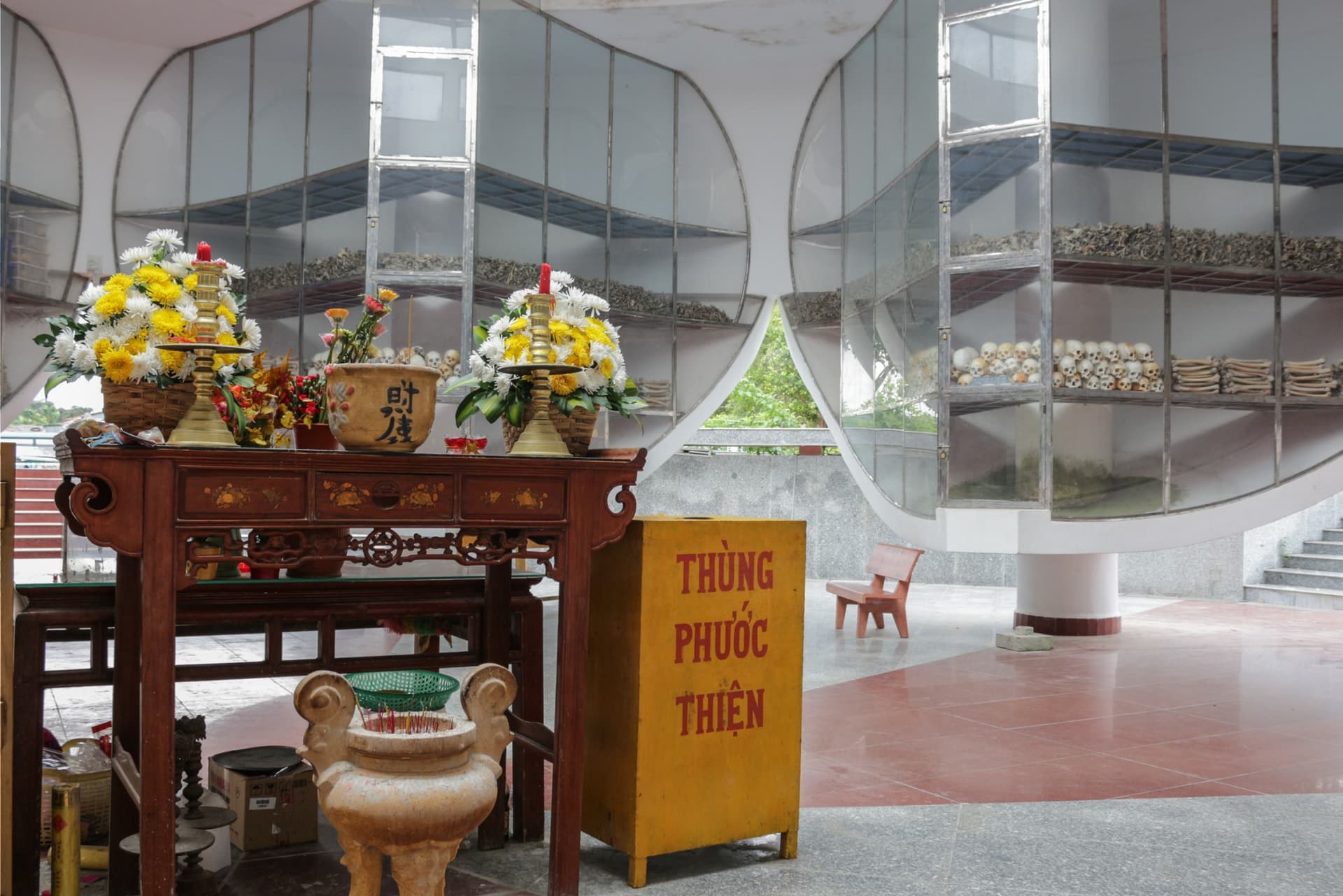
At the center of the site stands an octagonal ossuary housing the bones and skulls of more than a thousand victims, arranged by age group and gender. The austere structure was designed to allow visitors to walk around the remains displayed behind glass panels.
The Temple and the Pagoda of "Skulls"
The temple and the Pagoda of "Skulls" are the two main places of contemplation at Ba Chuc. The Phi Lai Pagoda and Tam Buu Pagoda, both linked to the local Buddhist community Tu An Hieu Nghia, were the sites of direct killings. Material traces of the massacre remain visible inside.
Photographs
The temple displays photographs taken shortly after the massacre. These images, accompanied by explanatory panels in Vietnamese and sometimes English, document the conditions in which the bodies were found. The visit, austere, requires some emotional preparation.
Practical Information
- Duration of visit: allow 1 to 1.5 hours to tour the ossuary, temple, and pagodas.
- Admission: free entry or a symbolic contribution, depending on the period.
- Dress code: proper attire required (shoulders and legs covered), as in any Vietnamese religious site.
- Photography: permitted outside; discouraged out of respect in areas of contemplation.
- Best season: the dry season (December to April) facilitates access via delta roads.
How to Get to Ba Chuc
Ba Chuc is located in Tri Ton District, An Giang Province, approximately 40 km southwest of Chau Doc and nearly 250 km from Ho Chi Minh City.
- From Chau Doc: the simplest option. Expect approximately 1 hour by private car or motorbike taxi. This is the option chosen by most travelers on Mekong Delta itineraries.
- From Ho Chi Minh City: approximately 6 hours by road, typically combined with a stop in Chau Doc or Long Xuyen.
- On site: the site is signposted at the village entrance. A parking area allows you to leave your vehicle before walking to the ossuary.
Combine With
Ba Chuc fits into a wider circuit through An Giang Province and the Mekong Delta:
- Bà Dên Mountain, a sacred peak in southern Vietnam, a few hours' drive away.
- Buu Long Mountain and Long An, a scenic stop on the return route to Ho Chi Minh City.
- The Ba Lai River, to extend your discovery of the delta.
- Ca Na, another coastal stop in southern Vietnam.
Integrate Ba Chuc Into Your Journey
A visit to the Ba Chuc memorial fits naturally into an itinerary through the Mekong Delta and An Giang Province. To build a circuit that combines memorial sites, rice-growing landscapes, and border villages, consult our Vietnam travel suggestions.

Interested in this visit?
We can include it in your personalised itinerary.