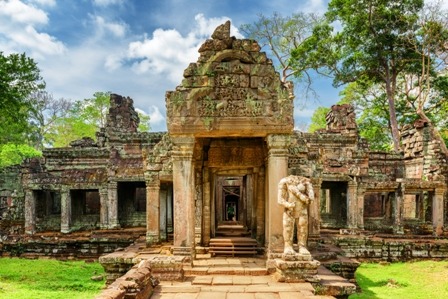
Phnom Kulen Mountain
Phnom Kulen Mountain
Located 50 km from Siem Reap, the sacred mountain of Phnom Kulen is home to a river carved with a thousand lingas, cascading waterfalls and the birthplace of the Khmer Empire founded in 802.
A sacred massif peaking at 487 meters, Phnom Kulen dominates the Angkor plain some fifty kilometers north of Siem Reap. It was here, in 802, that King Jayavarman II declared Cambodian independence from Java and founded the Khmer Empire. The mountain combines archaeological heritage, sacred springs carved with lingas, waterfalls, and a reclining Buddha sculpted directly from the rock.
Why Visit Phnom Kulen
Phnom Kulen is one of the founding sites of Khmer civilization. Before Angkor, it was on this plateau that the first imperial capital, Mahendraparvata, was established. The site offers multiple dimensions of interest:
- Historical significance: birthplace of the Khmer Empire in the 9th century.
- Religious importance: an active pilgrimage site frequented by Cambodians who come to pray and collect sacred water.
- Natural beauty: waterfalls, river, tropical forest and panoramic views over the Angkor plain.
- Artistic heritage: lingas sculpted into the riverbed and a monumental reclining Buddha statue.
Site History
In 802, Jayavarman II moved the Cambodian capital to Phnom Kulen, then named Mahendraparvata ("the mountain of great Indra"). Two years later, the king performed the "magical ritual" there that consecrated him as chakravartin (universal sovereign) and declared the country's independence from Java. This ceremony traditionally marks the birth of the Khmer Empire, whose successive capitals would later be established at Hariharalaya and then Angkor.
The plateau kept its secrets hidden beneath the jungle for centuries. LiDAR surveys conducted in the 2010s mapped the forgotten urbanism of Mahendraparvata, revealing a network of temples, basins and structured axes far more extensive than archaeologists had long supposed. The expanded Angkor area, of which Phnom Kulen is a part, has been inscribed on UNESCO's World Heritage list since 1992.
What to See
The River of a Thousand Lingas
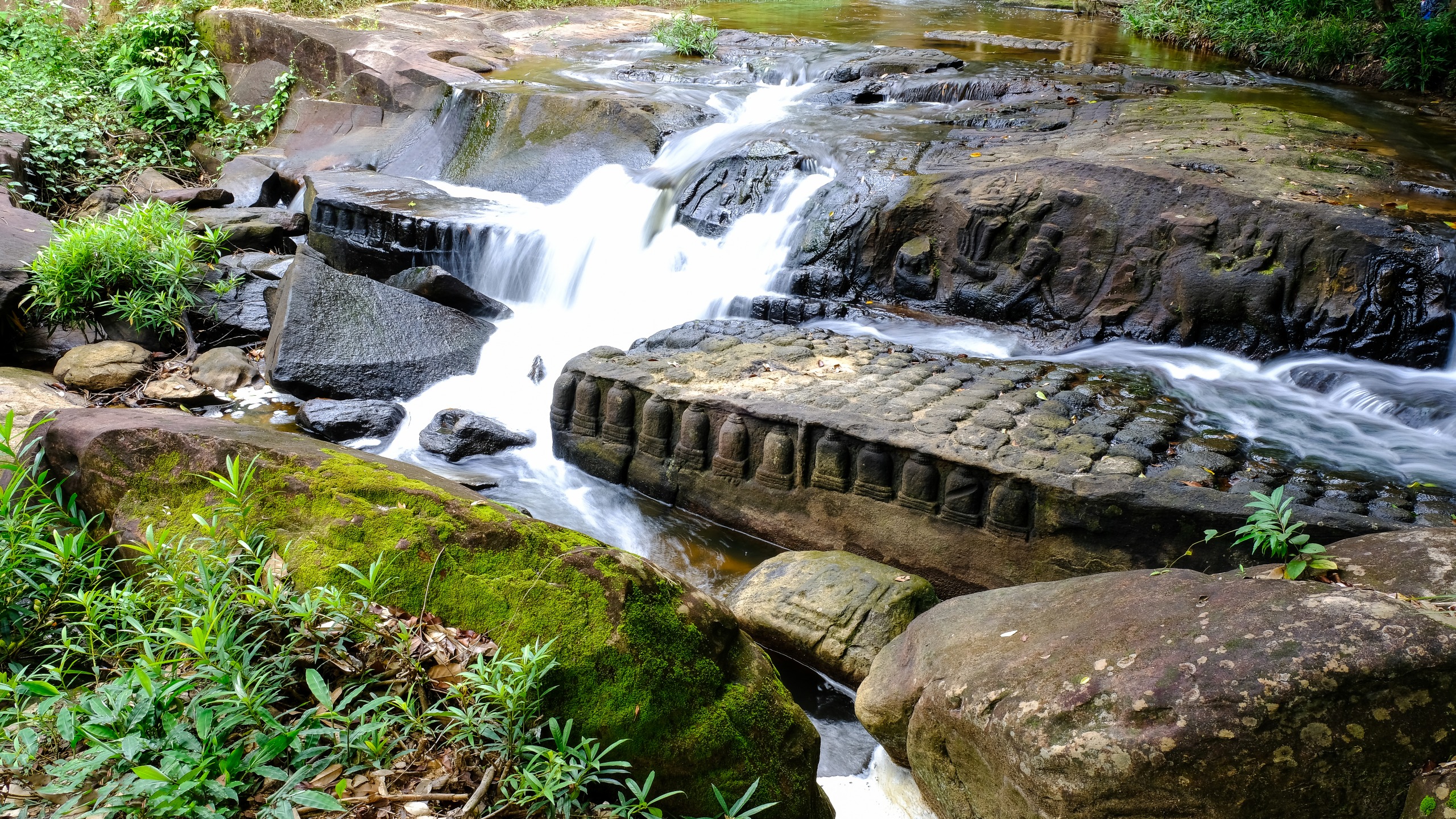
Over several hundred meters, the riverbed is carved with thousands of lingas — small circular monoliths symbolizing Shiva — arranged in regular grids. The water flowing over these sculptures is believed to be purified before irrigating the Angkor plain. Further upstream lies the spring itself: according to legend, a king suffering from leprosy was healed here. Even today, Cambodian devotees come to drink some of the water, pray, or leave money as a wish offering.
The Waterfalls
Downstream from the sacred river, two waterfalls form the site's most visited point. The main cascade drops some twenty meters into a basin where swimming is possible. The upper levels, calmer and more serene, are ideal for picnicking.
Wat Preah Ang Thom and the Reclining Buddha
Perched on a rocky outcrop, Wat Preah Ang Thom is a former Hindu sanctuary converted to Buddhism—a common transition in the region, though its dating remains debated among historians. The entrance is guarded by statues of lions, garuda, serpents and tigers, followed by a staircase leading to a statue of Vishnu and a five-headed naga balustrade.
The highlight of any visit is the Reclining Buddha, carved directly from an enormous block of sandstone. A rare feature: it rests on its left side, whereas virtually all reclining buddhas in the Theravada world are positioned on their right flank (the parinirvana posture).
The Sra Dumrei Rocks and Village Market
Off the main trails, deep in the forest, lie the carved rocks of Sra Dumrei depicting an elephant and other animals sculpted from stone. The small local village market is also worth exploring: it sells medicinal roots, animal skins and bones for traditional Khmer pharmacopoeia, alongside grilled food stalls and plateau fruits.
Practical Information
- Entrance fee: a specific ticket for Phnom Kulen is required (separate from the Angkor pass). It can be purchased in advance in Siem Reap, sometimes at a better rate than at the park entrance.
- Duration: plan for a full day from Siem Reap, including travel time.
- Access: the road to the summit is one-way with alternating hours (uphill in the morning, downhill in the afternoon). Best to start early.
- What to bring: clothing covering shoulders and knees for the temple, hiking shoes, swimwear for the waterfalls, water and snacks.
When to Visit
Phnom Kulen can be visited year-round, but the experience varies significantly by season.
- November to February: dry and cool season, ideal conditions for hiking. Waterfalls are still fed by the tail end of the monsoon.
- March to May: very hot, waterfall flow is reduced.
- June to October: frequent rains but spectacular waterfalls; some trails may become slippery.
For a balance of vigorous waterfalls and comfortable hiking conditions, the October-November window is generally most favorable.
How to Get There
Phnom Kulen is accessible only from Siem Reap, located some fifty kilometers to the southwest. Three options:
- Private car with driver: the most convenient option, arranged for the day, with rates negotiable through Siem Reap agencies.
- Tuk-tuk: possible for experienced travelers, but lengthy (allow over 2 hours each way).
- Organized excursion: often combined with other sites north of Angkor.
Expect approximately 1.5 to 2 hours of driving from Siem Reap, plus a walk from the parking area to the main points of interest.
Combine With
Phnom Kulen fits naturally into an Angkor itinerary:
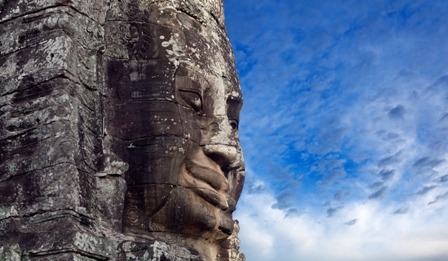
- Bayon Temple and its monumental faces, at the heart of Angkor Thom.
- The Terrace of Elephants, ancient royal reviewing stand of Angkor Thom.
- Siem Reap, the ideal base for exploring the region.
To incorporate Phnom Kulen into a complete Cambodge itinerary, explore our tailored Cambodge journeys.
Nearby
Interested in this visit?
We can include it in your personalised itinerary.