Battambang and Tonlé Sap
A provincial town with colonial shop-houses, pre-Angkorian temples dotting the rice paddies, and Southeast Asia's largest freshwater lake, which quadruples in size each year.
Battambang is Cambodge's second city by population, yet it remains intimate in scale, stretching along the Sangker River through a rice plain that has historically fed the nation. The town preserves a line of Sino-Khmer shop-houses and French colonial buildings from the 1900s-1930s, clustered around Phsar Nat market and streets 1, 1.5, and 2.5. This architecture—modest but coherent—gives Battambang a provincial character you won't find in Phnom Penh or Siem Reap anymore.
The province is also an active cultural hub. Phare Ponleu Selpak circus school has been training artists from underprivileged families since the 1990s, and its evening shows blend acrobatics, theatre, and live music. Several visual arts studios have opened in the city centre, and the traditional Khmer music scene (smot, funeral chants) is documented by local collectives. On the culinary side, Battambang is renowned for its pomelos, neighbouring Pursat oranges, and num banhchok—rice vermicelli served in the morning with a curry made from river fish.
Around the town, the plain is dotted with isolated hills crowned by sanctuaries: Phnom Sampov, with its caves once used as execution sites under the Khmer Rouge and its nightly exodus of millions of bats at dusk; Phnom Banan and its five pre-Angkorian towers from the 11th century, perched atop 358 steps; Ek Phnom, a pink sandstone temple from the 11th century located 11 km north, surrounded by pottery villages and dried rice cake producers. The "bamboo train" or norry—a bamboo platform mounted on axles that once ran on the single-track line between Battambang and Poipet—now operates as a tourist attraction on a renovated stretch at O Sra Lav.
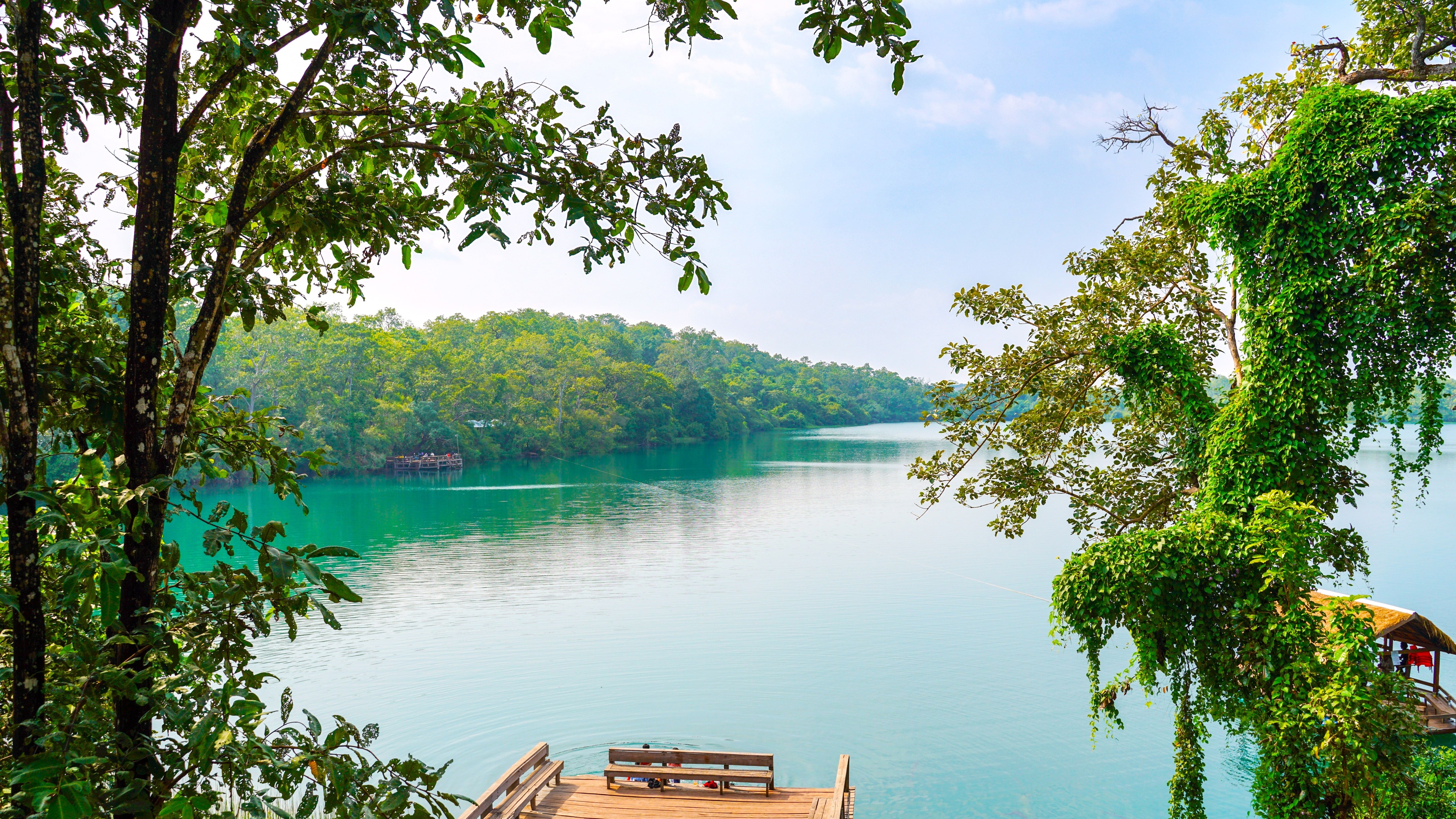
An hour and a half to the east lies Tonlé Sap lake, Southeast Asia's largest freshwater lake and a remarkable hydrological phenomenon. Its surface expands from roughly 2,500 km² in the dry season (April-May) to over 10,000 km² by the end of the monsoon (October), thanks to the Mekong's backflow, which reverses the flow of the Tonlé Sap River for five months. This annual pulse shapes all life around the lake: fishing, recession agriculture, the flooded forests of Prek Toal, and pirogue journeys.
The lake's populations live in three types of villages: floating (houses on rafts that rise and fall with water levels), built on stilts 6 to 10 metres high, and amphibious. Chong Kneas, closest to Siem Reap, has been heavily transformed by poorly regulated mass tourism, which we avoid. We direct our travellers towards Kompong Khleang, a stilt village of 6,000 residents on the lake's north-east, or towards Kompong Phluk, smaller still, where visits happen early in the morning with boatmen from the village. The Prek Toal bird sanctuary, accessible from Chong Khneas port, is home to colonies of spotted-billed pelicans, adjutant storks, and Asian open-billed storks, and is best visited between December and February.
The boat journey between Battambang and Siem Reap crosses the Sangker River, flooded forests, and the lake's western edge. The trip takes 6 to 8 hours depending on water levels and is comfortable only between September and early January; the rest of the year, pirogues run aground and the crossing is made by road in 3 hours.
To discover
Colonial architecture in Battambang. Stroll along streets 1, 1.5, and 2.5 past Sino-Khmer shop-houses, the Art Deco Phsar Nat market (1936), and restored former French administrative residences now converted into cafés.
Bats of Phnom Sampov. At the foot of Phnom Sampov, around 5:30 pm, several million bats pour from a cave in a long black ribbon that undulates above the rice fields for 30 to 45 minutes.
Kompong Khleang on stilts. A village of 6,000 inhabitants built on 8-metre-high stilts, traversed by motor pirogue. In the dry season, you walk at the foot of the houses; in October, water laps at the floorboards.
Prek Toal and its waterbirds. A biosphere reserve in the lake's north-west, reachable in 2 hours by boat from Chong Khneas. Pelicans, storks, and painted storks nest here by the thousands between December and February.
Phare Ponleu Selpak. A social circus school founded in 1994, where performers put on shows three to four evenings a week under a tent in Battambang's western outskirts.
When to go
The best period runs from November to February: temperatures between 22 and 30°C, clear skies, the lake still high after the monsoon, and migratory birds present at Prek Toal. March and April are hot and dry, with peaks of 36-38°C in Battambang's plain; the lake recedes and floating villages appear marooned on mud, radically changing the experience. From May to August, the monsoon brings short but intense showers (averaging 200 to 250 mm in July) that don't prevent visits but make tracks to Banan or Ek Phnom muddy.
For the boat crossing to Siem Reap, September and October are the only months when water levels guarantee a reliable 6 to 8-hour journey without running aground; between January and August, we advise against this option and favour the road (3 hours, 170 km via NR6).
Practical advice
We recommend 2 to 3 days on the ground: one day for Battambang town and the art studios, one day for the outlying temples (Banan, Ek Phnom, Phnom Sampov) and sunset with the bats, a third for Tonlé Sap if you choose Kompong Khleang or Prek Toal. Battambang is reached in 5 hours by road from Phnom Penh (291 km via NR5) or 3 hours from Siem Reap. There is no active commercial airport in the town.
The region flows logically between Phnom Penh and Siem Reap, making it a natural stop on a west-to-east itinerary of 12 to 15 days, extendable to the southern coast (Kep, Kampot) or the Mondulkiri highlands for travellers with 3 weeks. Hotel comfort is adequate if not luxurious: a handful of characterful guesthouses in colonial buildings and simple lodges near the lake. Battambang suits contemplative travellers, architecture and craft enthusiasts, and families with children aged 7-8 and up who will enjoy cycling through rice fields and boating on the lake.