Phnom Penh and the Mekong
A riverside capital at the confluence of the Mekong, Tonlé Sap and Bassac rivers, extending northward through Mekong villages and the last remaining Irrawaddy dolphins.
Phnom Penh occupies a unique hydrographic position in Cambodge. The capital sprawls at the confluence of three waterways: the Mekong flowing down from Laos, the Tonlé Sap which reverses its course with each monsoon, and the Bassac heading toward the Vietnamese delta. This meeting point, visible from Sisowath Quay, has shaped the city since the 15th century, when the Khmer court left Angkor to establish itself here. Today, two million inhabitants live among recent high-rises, French colonial villas and neighborhood markets.
We recommend exploring Phnom Penh through two focused days of sightseeing. The Royal Palace and its Silver Pagoda, still the residence of King Norodom Sihamoni, showcase 19th-century Khmer architecture along with a collection of gold and crystal Buddhas. The National Museum of Khmer Sculpture, just nearby, preserves major pieces from Angkor and pre-Angkorian sites like Sambor Prei Kuk—the finest introduction to statuary before a visit to Siem Reap. A few streets away, the central market Psar Thmei, an ochre-yellow Art Deco building inaugurated in 1937, remains the commercial heart of downtown.
Understanding contemporary Cambodge requires visiting memorial sites from the Khmer Rouge period (1975-1979). Tuol Sleng, a former secondary school converted into S-21 prison, and Choeung Ek, 15 kilometers southwest, where many of S-21's 17,000 detainees were executed, deserve half a day and an English-speaking guide. The audioguides produced by the Cambodge Documentation Centre are measured and factual. We recommend scheduling these visits in the morning, reserving the afternoon for somewhere more serene: Wat Phnom, the wooded hill that gave the city its name, or the French Quarter around the Central Post Office.
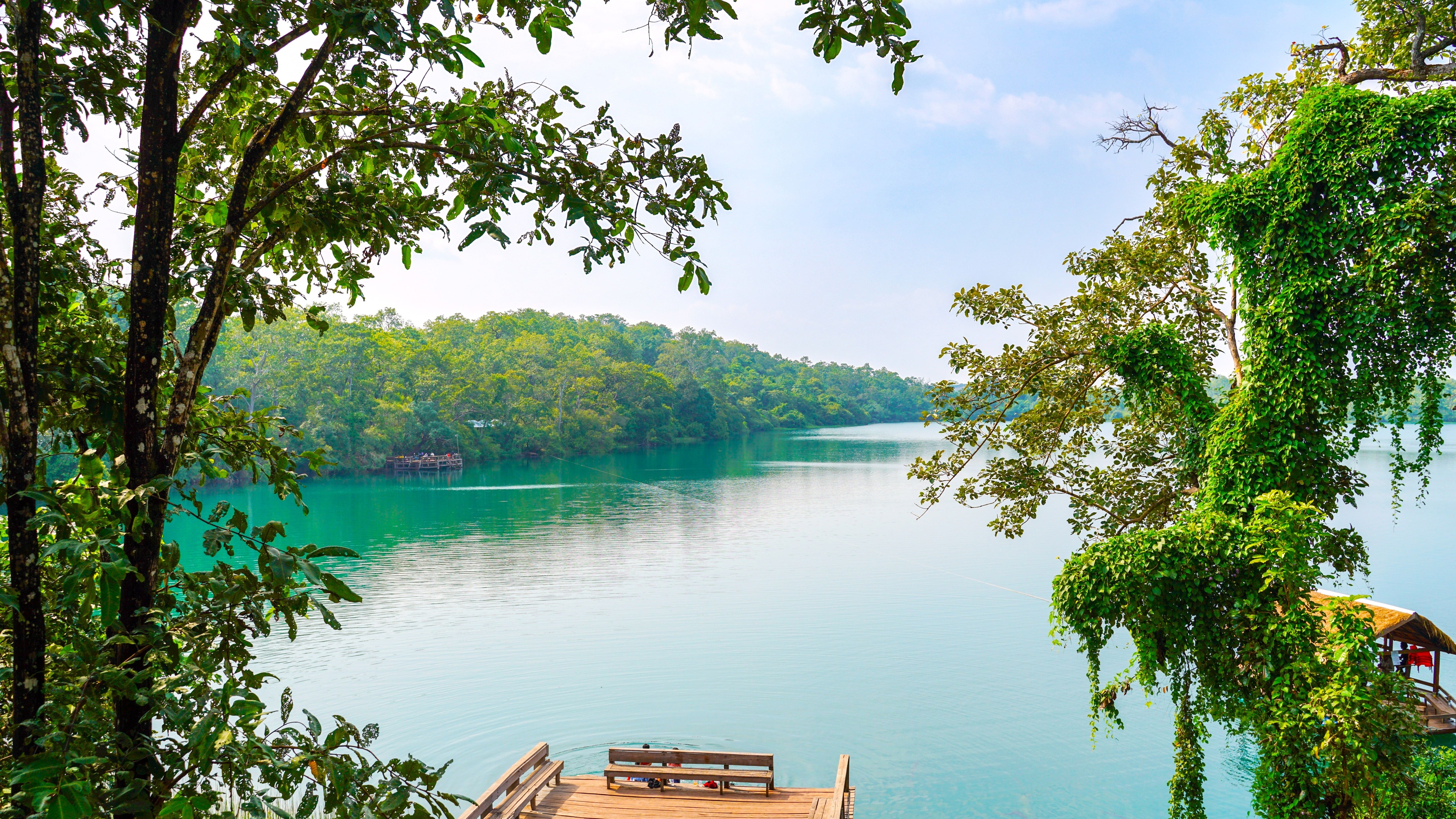
North of Phnom Penh, the Mekong can be traveled upstream for 350 kilometers to the Laotian border. Kampong Cham, 120 kilometers from the capital (2.5 hours by road), is a peaceful former colonial town whose riverbanks open onto Koh Pen island, accessible via a bamboo bridge rebuilt each year after the water level drops, around December. Further north, Kratie, 5 hours from Phnom Penh, is the observation point for Irrawaddy dolphins: fewer than 100 individuals remain in the Kampi reach, 15 kilometers upstream. Excursions take place in motorized pirogues at dawn or late afternoon, when dolphins surface to breathe. Stung Treng, even further north, appeals to travelers continuing into Laos via the Trapeang Kriel border crossing.
Closer to the capital, Koh Dach, known as Silk Island, can be crossed by ferry from the north bank in twenty minutes. A day's cycling suffices to tour family weaving workshops, mango and pomelo orchards, and small river beaches frequented by Phnom Penh residents on weekends. Further south, Koh Trong, opposite Kratie, offers similar rural-paced stops with several guesthouses operated by local families.
The region's cuisine reflects this fluvial geography. Freshwater fish is central: amok trei steamed in banana leaf with coconut milk and kroeung (citrus-herb paste), trei ngeat sun-dried, fermented prahok that flavors soups. At the night market in Daun Penh, num banh chok—rice vermicelli with tangy fish curry—is eaten at dawn. Our drivers will direct you to establishments run by the same families for three generations.
Must-See
The four waterways' confluence at sunset. From Sisowath Quay, observe the hydrological phenomenon where the Tonlé Sap reverses direction twice yearly, in May and October, driven by the Mekong's flood.
Irrawaddy dolphins at Kampi. Dawn pirogue excursion on the Kampi reach upstream from Kratie to see one of the last wild populations, estimated at fewer than 100 individuals.
A cycling day on Koh Dach. Ferry crossing from Phnom Penh then 25 kilometers of trails between silk-weaver workshops, orchards and wooden stilt hamlets.
Tuol Sleng and Choeung Ek. Half a day of remembrance at the former S-21 prison and nearby execution site, with audioguides produced by the Cambodge Documentation Centre.
National Museum of Khmer Sculpture. Pre-Angkorian and Angkorian statuary collection in a red-brick pavilion built in 1920, worth visiting before any trip to Angkor.
When to Visit
The most comfortable period runs from November to February: daytime temperatures around 28–30°C, cool nights at 22°C, clear skies, moderate humidity. This is also when the Mekong is receding, clearing the banks and facilitating pirogue outings in Kratie. The Bon Om Touk water festival, marking the Tonlé Sap's reversal, typically occurs in November at the full moon and draws millions of Cambodian visitors to Phnom Penh's quays.
From March to May, temperatures climb to 35–38°C with high humidity: the city feels heavy, especially in April, during Khmer New Year. The rainy season arrives from June to October, with showers concentrated in late afternoon, rarely disrupting city visits but making trails slippery on Koh Dach and Koh Trong. September and October are the wettest months, sometimes bringing localized flooding along the quays.
Practical Tips
We recommend two to three days in Phnom Penh itself, then two to three additional days if you wish to travel up the Mekong to Kratie for the dolphins, with a night in a guesthouse on Koh Trong. Phnom Penh International Airport is the country's main entry point, served from Bangkok, Singapore, Ho Chi Minh City and Doha. The capital logically connects with Siem Reap and Angkor to the north (5 hours by road or 45 minutes by air), with Battambang and Tonlé Sap via National Road 5, or with the southern coast and Koh Rong island via Kampot and Sihanoukville (3–4 hours by road).
Comfort levels are high in Phnom Penh: charming hotels in renovated colonial villas, contemporary establishments run by Khmer or French chefs, private taxis and tuk-tuks via app. In Kampong Cham and Kratie, accommodation is simpler—well-maintained guesthouses or ecolodges. The region suits travelers curious about contemporary history, families with children aged 10 and up for memorial visits, and contemplative visitors who will appreciate the rhythm of days spent on the Mekong.