Miraculous Rediscovery in Cambodia of a Critically Endangered Species
In Mondulkiri, researchers found 18 shells of Bertia cambojiensis, four of which still housed living snails. A rare discovery for Cambodian biodiversity.
The Cambodian scientific journal Cambodian Journal of Natural History, established in 2008 notably by the Royal University of Phnom Penh to help Khmer scientists share their discoveries and improve their editorial approach, recently published surprising news that has sparked considerable reaction in the Cambodian press. The Bertia cambojiensis, a giant snail critically endangered and thought to be extinct in Cambodia after recently being found only in the forests of southern Vietnam, has indeed been rediscovered in Khmer territory! It had originally been discovered in Cambodia in 1860.
18 individuals discovered
The journal's announcement was made in recent days, though this rediscovery dates back eighteen months ago. The researchers at the Cambodian Journal of Natural History preferred to take time studying their natural habitat to protect them before making the information public. Discovered in O'Reang district, in Mondulkiri province, the area forming part of the Keo Seima Wildlife Sanctuary, these snails are necessarily exposed to deforestation if they venture beyond the protected boundaries.
It was thus in November 2018, at the onset of Cambodia's dry season, that researchers discovered 18 giant shells of Bertia cambojiensis. Unfortunately, 14 of them were empty, but their astonishment was boundless when they found that 4 shells still housed living snails within them.
Soon to be known by all
The animals were observed in the middle of a forest within the sanctuary, on relatively dry leaf litter despite recent passage of the rainy season, close to a stream. Others were also found in the shade of fallen logs or tree trunks.
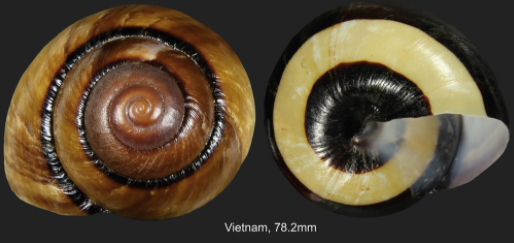
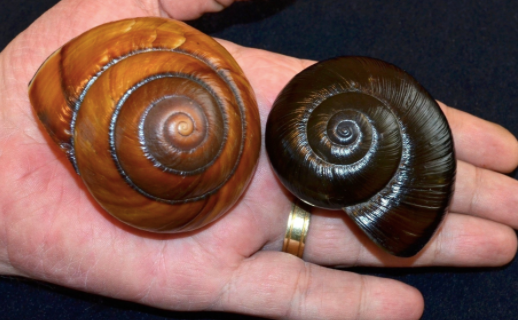
The shell of the giant snail, with its helical shape, measures about the size of an adult's palm! Its pale, black, or brown coloring blends perfectly with the hues of its natural forest habitat.
The Cambodian Journal of Natural History, published biannually, comes out each year in December and June. There is therefore a strong likelihood that the scientists from the Biodiversity Conservation Centre (CBC) of the Royal University of Phnom Penh will publish a detailed article on the bertia cambojiensis next month. The CBC is a nonprofit unit dedicated to training Cambodian biologists and to the study and conservation of Cambodia's biodiversity.
Frequently asked questions
The bertia cambojiensis is a giant snail critically endangered and first discovered in Cambodia in 1860. Its helical shell measures about the size of an adult's palm.
The Keo Seima Wildlife Sanctuary in Mondulkiri province can be visited, but it is important to respect conservation rules to protect endangered species.
Researchers discovered 18 shells in November 2018, 4 of which still housed living snails.
Images restored from the source website — reposition manually if necessary.