Transportation in Cambodia: how to get around the city?
In Cambodia, getting around requires some adaptation: between tuk-tuks, rickshaws, buses, taxis, bicycles or scooters, each option caters to a different pace of travel and level of comfort.
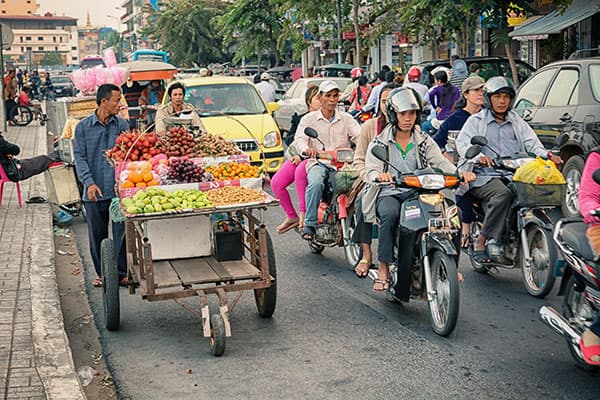
Like Phnom Penh, Cambodia's capital, cities are not always designed with pedestrians in mind. Within major urban centers, traffic can become a real headache when you're caught in the chaos of scooters, tuk-tuks and other vehicles that flood the streets. To avoid certain inconveniences, here are some transportation options that will make getting around during your stay in Cambodia easier.
Traffic in Cambodia
It's well known that navigating traffic in Cambodia is not easy if you're not used to it. Between the sound of honking horns, disregard for traffic rules and safety regulations, it's no wonder some travelers feel "thrown off". Indeed, right-of-way rules in Cambodia don't really apply—it's more about who forces their way through first. The same goes for safety; don't be surprised to see four people on a single scooter without helmets. Despite a high rate of accidents daily, locals don't always share the same instincts when it comes to road safety.
Choosing a mode of transportation suited to your Cambodia stay
There's no point looking for trams or subways in Cambodia—they simply don't exist. To get around, you'll need to rely on widely available tuk-tuks and numerous other transportation options.
Exploring cities by bicycle
Cycling through Cambodia's cities can be quite a challenge, as some are better suited than others given traffic density. This is why you'll find few cyclists in Phnom Penh, for example. The heat can also be a deterrent depending on when you travel to Cambodia.
However, this mode of transport is very affordable. You can rent a city bike for less than 3€ per day or a mountain bike for under 5€.
Getting around by tuk-tuks and rickshaws
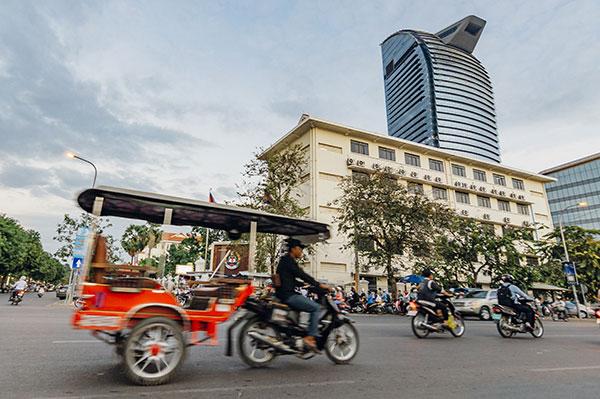
Using tuk-tuks and rickshaws is very common in Cambodia. They differ by capacity: rickshaws hold up to 3 people while tuk-tuks accommodate up to 5. You won't have trouble finding one since they're stationed on nearly every corner. However, many drivers can't read GPS or speak English. It's highly recommended to know your route so you can direct the driver if he's unfamiliar with it.
As for tuk-tuk fares, expect around 0.80€ per kilometer, though in reality prices can vary considerably. Some drivers take advantage of tourists' unfamiliarity with local pricing to inflate the bill.
To avoid this kind of overcharging, PassApp seems to be the right solution for all trips in Phnom Penh and Siem Reap. Recently launched, this mobile app lets you easily book a ride with prices shown upfront and a map displaying the route and travel time.
Renting a scooter in Cambodia
For the more adventurous, renting a scooter offers greater freedom and is more economical than tuk-tuks if you travel frequently. Expect around 7€ per day with helmet included. No international license is required to ride a motorcycle under 125 cc—only your passport is needed as a vehicle deposit. However, you'll need nerves of steel to handle tailgating and other local driving habits. Also note that good sense of direction is essential to navigate the city freely.
Taking a Khmer taxi
You'll also find traditional taxis, though expect to pay roughly double what you'd spend on a tuk-tuk. They offer more safety than two-wheeled vehicles, but the journey may take slightly longer since they can't weave between cars the way scooters do.
Using city buses
Cheaper than tuk-tuks, you can get around town for just a few cents. Bus stops are serviced daily from 5:30 AM to 8:30 PM, which can be a good alternative to tuk-tuks and rickshaws. Plus, you'll enjoy better safety while avoiding price negotiations.
National buses
Far cheaper than flying for traveling between cities in Cambodia, you can rely on the many bus companies operating throughout the country. Fares vary depending on the vehicle type and condition as well as travel time. Departure times also affect pricing. For example, a Phnom Penh–Siem Reap trip can cost around 5€ for 7 hours of travel or 12€ for 5 hours by minivan.
Departures typically happen early morning through early afternoon for daytime buses. Generally speaking, rest stops during travel and punctuality are highly unpredictable. It's not uncommon for a bus to fail to show, so it's wise to book at a physical counter rather than online to ensure you can reach the company if there's a delay or other issue.
Night buses, meanwhile, are very useful for longer journeys since they let you save on accommodation and gain a full day of sightseeing during your Cambodia stay.
Frequently asked questions
City buses are the most economical at just a few cents per trip, followed by bicycles at 3€/day.
No, no international license is required for motorcycles under 125 cc. Only your passport is needed as a deposit.
Use the PassApp application in Phnom Penh and Siem Reap to know prices in advance, or ask locals about standard fares before negotiating.
City buses typically run from 5:30 AM to 8:30 PM daily with regular stops throughout the city.