Temperature Drop Caused by Typhoon Usagi
Across Cambodia, the passage of Typhoon Usagi brings an unusually cool start to the dry season, marked by sustained rainfall, strong winds, and notably lower temperatures.
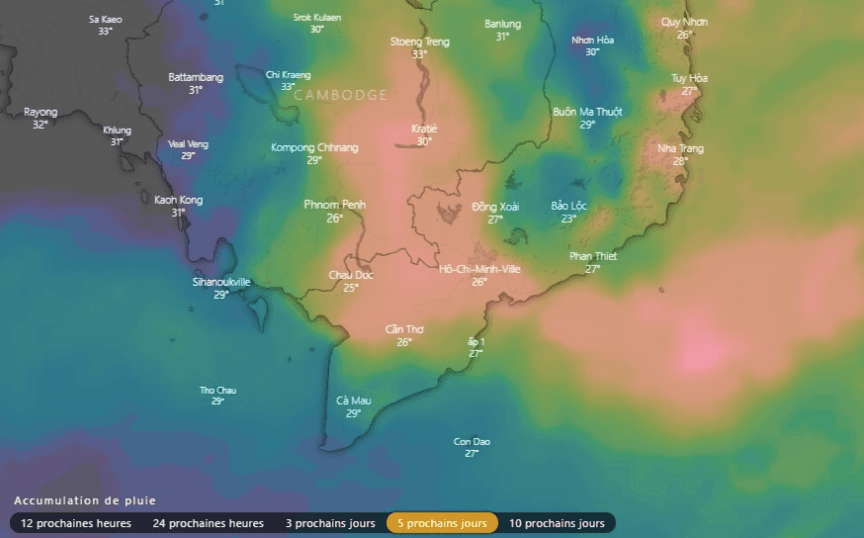
Persistent and heavy rains have been battering Cambodia and the capital Phnom Penh since Sunday evening. Typhoon Usagi, currently striking Vietnam, is making its presence felt across the central and southern parts of the kingdom. Temperatures have dropped significantly, offering a refreshing change as the dry season begins. The sensation is unusual, striking. Over the past few days, it's easy to forget a sweater—necessary for passing the day comfortably outdoors in Cambodia and Phnom Penh. The wind is crisp and ambient temperatures have dipped from 23°C without notice to 18°C, during a period when the mercury typically breaches 30°C without hesitation. Typhoon Usagi, which crossed the Ho Chi Minh region yesterday, is now heading north and will eventually spend itself over the South China Sea. In the meantime, the Khmer regions of Phnom Penh, Kratié, Stung Treng, and Ratanakiri are experiencing collateral climate shifts. Nothing dangerous if one takes care. Rain, crisp wind, and a drop in the mercury are settling into these provinces and compelling their inhabitants to dress more warmly than usual. Kingdom-wide temperatures should return to normal by the end of the weekend, with sunshine to boot.
The Term Typhoon
Usagi adds itself to a roster of 35 previous typhoons this year. The last, Man-Yi, was heading yesterday toward the southwest of the Philippine Sea. All typhoons are classified as such in the northwest Pacific zone. They are storms. The term hurricane is used in the North Atlantic and northeast Pacific, and cyclone in the Indian Ocean and South Pacific. The three terms fundamentally describe the same type of climate phenomenon.
 In yellow, the zones of influence of Typhoon Usagi, last Sunday
Frequently asked questions
According to forecasts, temperatures should return to normal by the end of the weekend, with the return of sunshine.
The primarily affected regions are Phnom Penh, Kratié, Stung Treng, and Ratanakiri, which are experiencing rainfall, crisp winds, and a drop in temperatures.
These three terms describe the same climate phenomenon, but in different zones: typhoon in the northwest Pacific, hurricane in the North Atlantic, and cyclone in the Indian Ocean.