Discovering the Temples of Angkor
Angkor Wat embodies the grandeur of the Khmer empire on its own. Between sacred architecture, bas-reliefs, majestic towers, and religious symbols, the site fascinates as much as it moves.
The Angkor site, in Cambodge, is a remnant of the Khmer empire. It was Emperor Suryavarman II who ordered the construction of the Angkor Wat temple, the largest temple of the ancient Khmer capital and today the world's largest religious building. Nearly forty years were required to build it entirely. Its former name meant "temple-city" in Khmer. Angkor Wat is the symbol of Cambodge, and it is believed to have been a funerary temple. Today, it is a place of Buddhist pilgrimage, though it once served to worship kings and the Hindu god Vishnu.
Angkor Wat covers an area close to 200 hectares, the wall surrounding the site measures 1,025 meters in length and 800 meters in width. Built south of the capital of Angkor Thom, it occupies the southeastern part of the ancient city of Angkor. Archaeologists believe that the "tomb of Lou pan" south of the capital may belong to the Angkor Wat site, which would confirm the theory of a funerary temple. The old city of Angkor is surrounded by a wall over 12 kilometers long. It resembles an immense fortress where precious treasures are said to be hidden.
A thousand-year history to tell
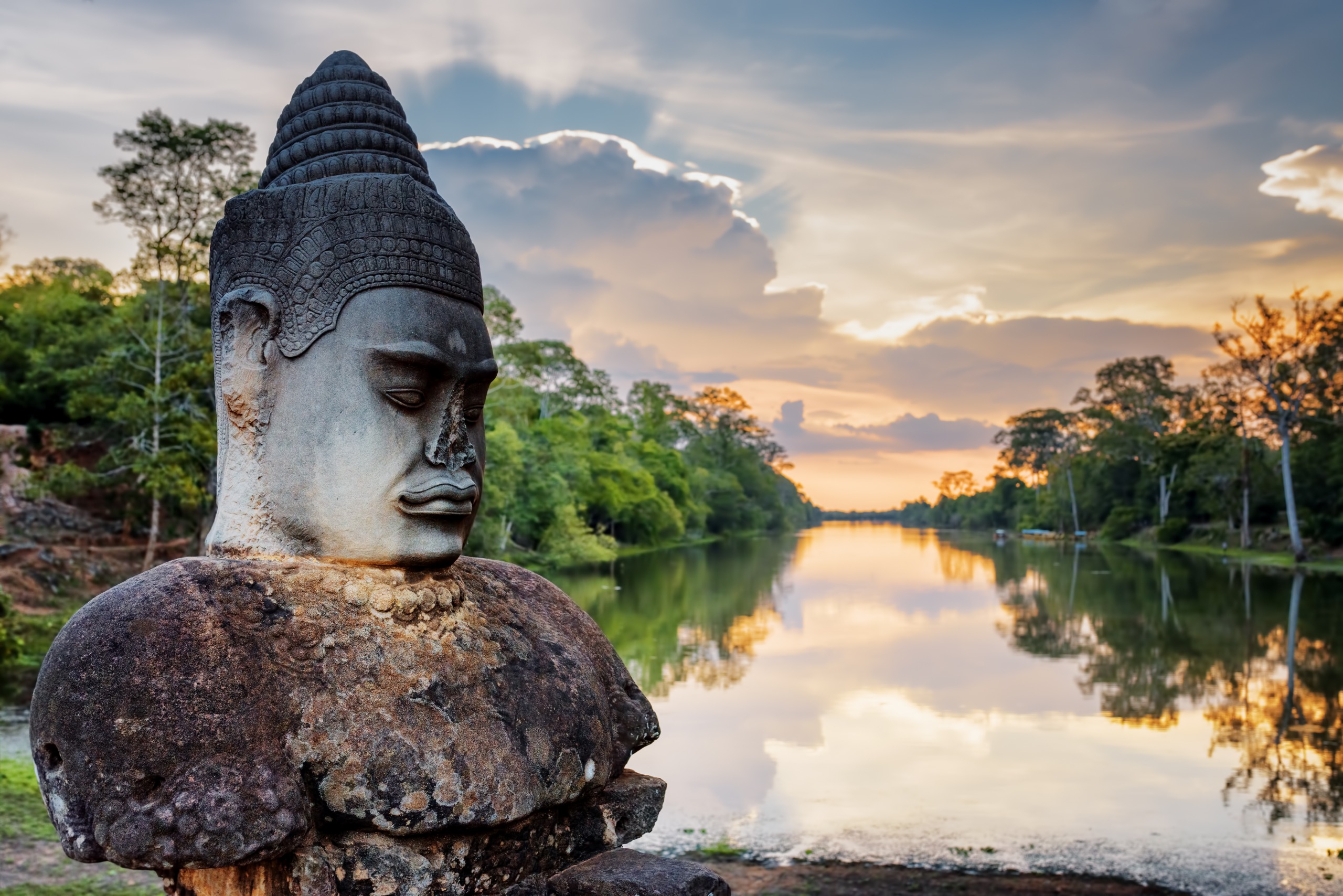
Like most temples at Angkor, Angkor Wat was built following the traditional architecture of temple-mountains and gallery temples, and thus symbolically represents the myth of Mount Meru, the center of the world in Hinduism. The site is protected by moats, and the site presents a logical structure with perfect proportions, making it a harmonious place. As you move closer to the gigantic towers on which smiling figures have been sculpted, you will see, at the Bayon, scenes of life depicting the Khmer past. Several worlds overlap, the world of gods precedes that of kings, while below it is the world of the people and servants who are shown witnessing a cockfight. Some historical events are also depicted, such as the naval battle between the Khmer and the Chams.
The two most famous monuments of this immense archaeological site are Banteay Srei where you will find pink sandstone sculptures, and the apsara sculptures which represent young female warriors of perfect beauty. You will marvel at seeing the delicate features of each one of them.
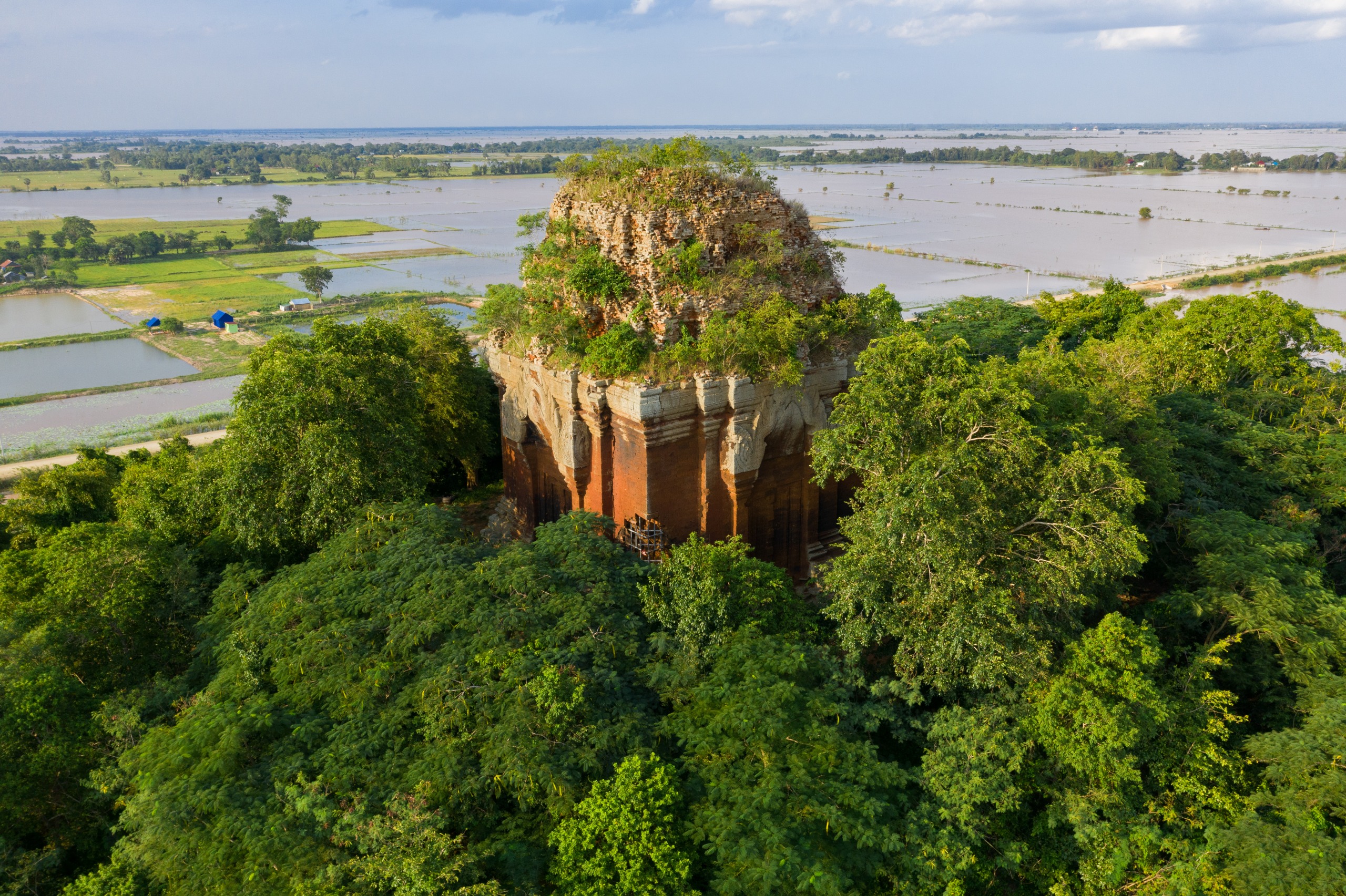
The Preah Palilay temple, surrounded by gigantic trees, is also among the must-see monuments.
Nature maintains its rights here
Given the size of the site, several days will be needed to discover the vast majority of temples and monuments at Angkor. Be sure not to miss witnessing a sunset over the Srah Srang basin, this landscape of absolute serenity will likely become one of your most memorable memories.
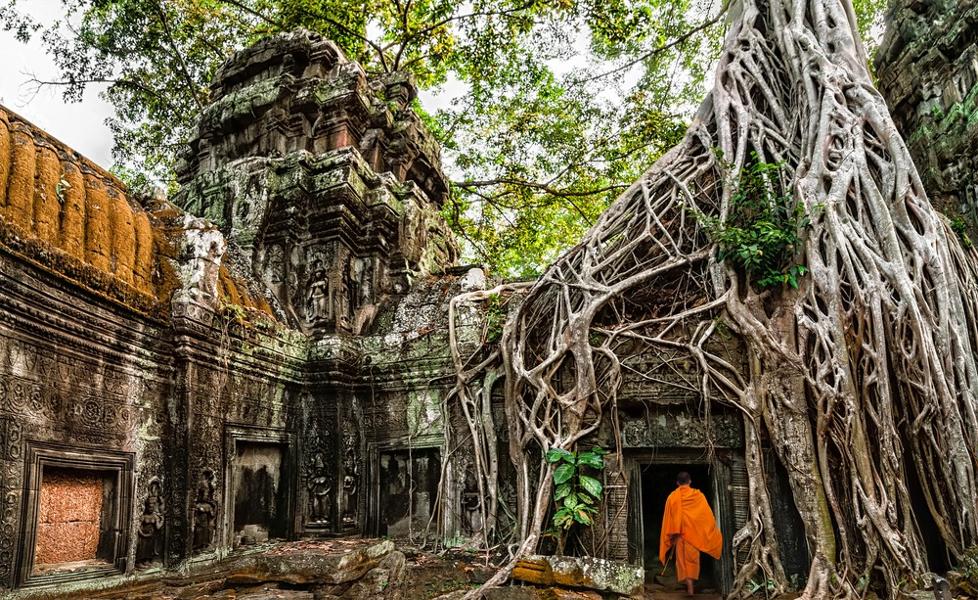 Vines and interwoven tree roots invade the Ta Prohm, which has not yet been restored. This will give you an idea of the state the Angkor monuments were in before restoration began. It is a long and arduous work that, nevertheless, proves necessary if we wish to preserve one of humanity's most beautiful heritages. There the forest quickly reclaims its rights, and man must constantly intervene if he wishes to keep the place intact.
In two days, you will not tire of walking the long pathways of the world's largest archaeological park. You will discover around each bend a temple, statues, a wall. Angkor Thom (Great Angkor) is surrounded by a wall four kilometers long, adorned with five gates above which the principal kings of Cambodge have been sculpted. The site was built a few decades after Angkor Wat was erected by King Jayavarman VII. If you go to Angkor Wat, you cannot avoid visiting Angkor Thom; the two are located nearby. It is by walking a few minutes through the jungle, starting from Angkor Wat, that you will arrive at the site. The Bayon, located in the center of the fortified city, is one of Angkor's most famous monuments.
Angkor, a tourism classic
Located near the city of Siem Reap, the entire Angkor site is now part of UNESCO's world heritage. Its temples are Cambodge's primary tourist destination. It is an exceptional site for its size; across 800 km², there are 1,200 Khmer temples listed. During their visit, tourists will regularly encounter Buddhist monks.
It is a part of Cambodge where traditions endure. Inside the five towers of Angkor Wat, you will see old women burning incense sticks. Angkor Wat, the main temple of the ancient Khmer capital, well illustrates this blend between the two religions, Hindu and Buddhist.
Tourism is expanding greatly in Cambodge, and hotel complexes have been built to meet demand. Angkor is a flagship destination, as is Phnom Penh. A few days are sufficient to visit these two main tourist sites.
Sheltered by a massive wall, you will enter the depths of one of Asia's most beautiful archaeological sites. Angkor Wat, the most important temple at Angkor, is a jewel of Khmer architecture. Amid a hostile jungle, temples and monuments stand proudly before the visitor, enchanted by an almost magical setting.
Keen to discover Cambodge?
Our English-speaking local experts create your tailor-made journey
Request a quoteFrequently asked questions
There are several types of passes to visit Angkor: 1-day, 3-day, or 7-day passes. Prices vary depending on the duration chosen.
Plan for a minimum of 2-3 days to see the main temples. A week allows for a complete and thorough visit.
The sunrise over Angkor Wat is spectacular. Arrive early to avoid crowds and enjoy the golden light.
Several options: tuk-tuk, bicycle, car with driver. Cycling is eco-friendly but tiring in intense heat.