Angkor Thom
Angkor Thom
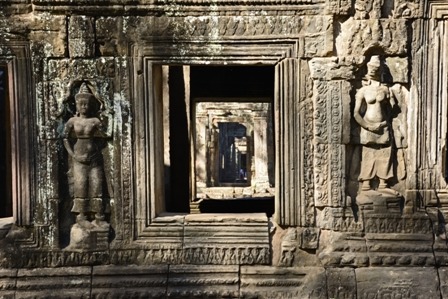
Ancient Khmer capital founded by Jayavarman VII in the late 12th century, Angkor Thom brings together the Bayon, the Baphuon and the royal terraces across 9 km².
Ancient capital of the Khmer empire founded in the late 12th century, Angkor Thom forms a vast fortified quadrilateral of 9 km² located approximately 2 km north of Siem Reap. Surrounded by 8-meter ramparts and a moat spanning dozens of meters, the city shelters several major monuments of the Angkor archaeological park: the Bayon, the Baphuon, the Phimeanakas and the Terraces of the Elephants and the Leper King.
Why visit Angkor Thom
Angkor Thom condenses the principal evolutions of Khmer architecture under Jayavarman VII's reign (1181-1218) into a single site. You observe the synthesis between Mahayana Buddhism and Hindu cults of Shiva and Vishnu, readable in the bas-reliefs and iconography of the temples. Unlike Angkor Wat, which is more monumental and homogeneous, Angkor Thom offers an urban walk between five monumental gates, a vanished royal palace, ceremonial terraces and temple-mountains. Plan for a minimum of half a day to explore the enclosure without rushing.
History
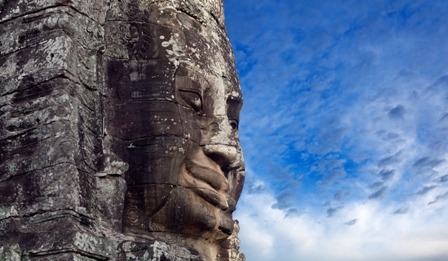
Angkor Thom ("the great city" in Khmer) succeeded Yasodharapura as the empire's capital after the sacking of Angkor by the Chams in 1177. Jayavarman VII launched its reconstruction from 1181 and completed most of the work by the end of the 12th century. The fortified city was designed according to a square plan oriented to the cardinal points, with five monumental entrance gates decorated with giant faces—most often interpreted as those of bodhisattvas or Jayavarman VII himself, rather than as Hindu deities.
Capital of an empire that then radiated across much of mainland Southeast Asia, Angkor Thom housed several tens of thousands of inhabitants, served by a network of roads, canals and basins. Decline began in the 15th century, after Angkor was taken by Siamese armies in 1431 and the Khmer political center gradually shifted southward. The temples were progressively abandoned and swallowed by the forest, though never entirely deserted.
Their rediscovery by European explorers in the 19th century, followed by the founding of the French School of the Far East (EFEO) in 1900, opened a long sequence of surveys, studies and restorations that continues today as part of the site's UNESCO World Heritage classification.
What to see at Angkor Thom
The gates and ramparts
Five monumental gates cross the moat: the south gate (best preserved and most photographed), north gate, west gate, east gate and Gate of the Dead. Each is topped by a tower sculpted with four giant faces turned toward the cardinal points. The access causeways are lined with rows of divinities and demons pulling the body of the serpent Vasuki, illustrating the myth of the Churning of the Ocean of Milk.
The Bayon
The last state temple built at Angkor Thom, the Bayon stands at the exact center of the city. Its 49 towers carved with giant faces, arranged around a central sanctuary, constitute the most recognizable image of the site. The lower galleries bear nearly 1.2 km of bas-reliefs depicting naval battles against the Chams as well as scenes of daily life in the 12th century.
The Baphuon
Predating Angkor Thom, the Baphuon is the largest temple-mountain at Angkor. On its western face, stones were repurposed in the 16th century to form a reclining Buddha approximately 70 meters long, still visible today. Dismantled stone by stone by the EFEO using the method known as anastylosis, the temple reopened to the public in 2009 after several decades of construction interrupted by civil war.
The Phimeanakas and royal palace
The Phimeanakas, or "Heavenly Palace," is a Hindu temple built around the 10th century, predating the city. It features a pyramidal architecture in laterite and sandstone, erected within the royal palace enclosure. The palace itself, built with perishable materials, has today disappeared: only stone terraces and basins remain.
The Terraces of the Elephants and the Leper King
The Terrace of the Elephants stretches for 300 meters facing the great royal plaza. Its facade is sculpted with elephants, lions, Garudas and five-headed horses, roughly life-size. To the north, the Terrace of the Leper King displays on both sides a wall covered with bas-reliefs of nagas and Garudas. The statue that gave it its name is a replica: the original is preserved in the National Museum of Phnom Penh.
Practical information
- Entry ticket: access to Angkor Thom is included in the Angkor Pass, valid for the entire archaeological park. Three options exist (1 day, 3 days, 7 days).
- Duration of visit: plan for half a day to see the main sites, a full day to explore the enclosure in detail.
- Dress code: shoulders and knees covered to enter active temples. Closed-toe shoes recommended for the steep stairs of the Baphuon and Phimeanakas.
- Water and sun: little shade on the terraces and esplanades; bring water and a hat.
When to visit Angkor Thom
The dry season, from November to March, offers the most comfortable conditions, with bearable temperatures and little rainfall. The rainy season (May to October) makes vegetation denser and light more contrasted, but brief showers are to be expected. For photography, morning light enhances the south gate and the Bayon faces, while late afternoon suits the Terrace of the Elephants and the Baphuon better.
How to get there
Angkor Thom is located approximately 8 km north of central Siem Reap, after the main entrance to Angkor Park.
- Tuk-tuk: the most common and economical way. Most drivers offer full-day circuits including Angkor Wat, Angkor Thom and Ta Prohm.
- Bicycle: a pleasant option in the dry season for independent travelers; the terrain is flat but distances between temples are considerable.
- Car with driver: recommended for hot days or groups, and essential if you combine Angkor Thom with distant sites like Banteay Srei.
Nearby
Angkor Thom integrates naturally into a broader circuit through Angkor Park from Siem Reap. Among complementary sites worth considering:
- Banteay Kdei, a 12th-century Buddhist monastery, more discreet than its neighbors.
- Banteay Samre, a well-preserved temple in Angkor Wat style, away from the main flows.
- Bakong, the first great Khmer temple-mountain, in the Roluos group.
Frequently asked questions
Frequently asked questions
Prepare your trip
Angkor Thom features in most cultural itineraries in Cambodge. To integrate this site into a tailor-made circuit combining Siem Reap, Phnom Penh and the coast, consult our Cambodge travel suggestions.
Nearby
Interested in this visit?
We can include it in your personalised itinerary.