Lakhon Khol rises from the ashes
In the village of Taskor, the masked theatre Lakhon Khol is coming back to life thanks to students, local artists, and the NGO Good Fun, blending cultural transmission with renaissance.
14 Feb. 2019
Lakhon Khol. This art form has been inscribed since 28 November 2018 on UNESCO's List of Intangible Cultural Heritage in Need of Urgent Safeguarding. The masked theatrical performance, created in the 7th century in the village of Taskor, has been experiencing a revival for the past 14 years under the guidance of Marie-Claude and Hubert Macé of the NGO Good Fun. They now hope the troupe will export its art and eventually welcome tourist audiences to monetize this activity.
The village of Taskor is located 18 km from the capital Phnom Penh. On the other side of the Mekong, deep in the countryside. Along the banks of the river, the contrast is striking. A glance to the right is enough to glimpse the imposing skyscrapers of the Koh Pich district, even though it stands in the middle of a hamlet surrounded by water, forests, and fields. Here stands the Wat Svay Andet pagoda, literally floating mangoes, a reference to the many fruit trees in the area caressed by rising waters during the monsoon season. The vast expanse of land dedicated to this religious temple also hosts Taskor's nursery and primary school, as well as a brand new building dedicated to the training and practice of Lakhon Khol.

The Lakhon Khol theatre at Wat Svay Andet, in the village of Taskor. ©PierreMotin
The revival
It is in the cool countryside of Cambodia that this traditional Khmer theatrical art has resided for over 1,300 years. Troupes even multiplied throughout the country after its creation. But this longevity has been marked by long periods of artistic void. The first came during what is known as Cambodia's Dark Ages, just after the fall of the Empire (early 15th century) until the French protectorate in 1863. The country was besieged by the Siamese, who repeatedly attacked theatres housing masked troupes. Lakhon Khol gradually lost momentum until the support, in the 20th century, of King Sisowath and later, in 1948, his grandson King Norodom Sihanouk, who both visited the birthplace of this traditional art in Taskor. But the worst, concerning all Cambodian creative intelligence, was yet to come. Between 1975 and 1979, the Khmer Rouge silenced all forms of art and culture that did not serve their propaganda. Survivors of the Angkar who later returned to Taskor, their native village, attempted to revive Lakhon Khol. In 2005, Marie-Claude and Hubert Macé decided to establish the Good Fun association to help the village rebuild. "I first came here to administer malaria vaccinations to the local population," Marie-Claude explains. "We realized that the children attended the village school but lacked adequate materials. So we decided to provide them with supplies, and we were immediately struck by the Lakhon Khol—they were still practicing it in Taskor in a room sponsored by UNESCO within the village. The artists now have a new building in the heart of the school courtyard, close to the pagoda." Before the Khmer Rouge arrived, eight masked theatre troupes performed in Cambodia; afterwards, only the one in Taskor, the birthplace of this art, remained.

Two giant masks from the Lakhon Khol performance ©PierreMotin
UNESCO indeed participated in the revival of masked dances by also fabricating the instruments necessary for the troupe's orchestra. With an annual budget of 130,000 euros, the Good Fun association wishes to continue financial oversight of this place. "The artists create their own costumes. Today we want to dedicate more funds to provide them with better raw materials," Hubert concedes, pulling masks from the shelf. The theatre, sheltered by a roof but open on all sides, resembles a courtyard and incorporates the office of the troupe's director, which also serves as a changing room and storage for costumes.
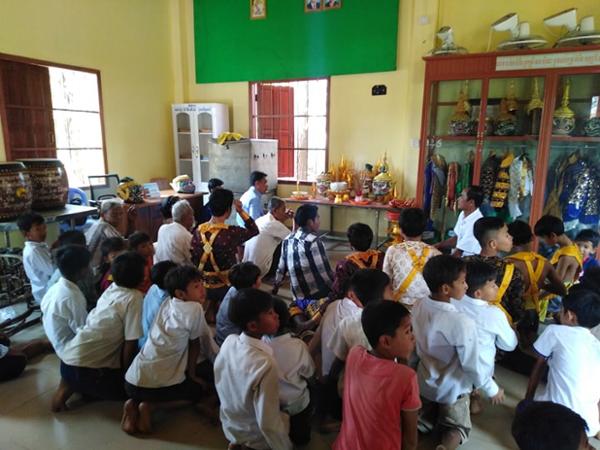
The director's office where dancers change and costumes are stored. ©PierreMotin
The monkeys assault the giants
The art of masked theatre Lakhon Khol narrates many Khmer folk legends. The most well-known is the Sanskrit epic Ramakerti, the Khmer version of the Ramayana, which recounts the journey of Rama, one of the seven avatars of the Hindu god Vishnu. The performance, being worked on at the beginning of this year by the Taskor troupe, unfolds in three stages. A ceremony of prayers and offerings set to traditional Khmer music performed by the group's orchestra. Then the orchestra alone keeps spectators on the edge of their seats before the costumed and masked dancers take the stage. In the legend, Prince Rama is hopelessly in love with Sita, one of the avatars of Lakshmi, the goddess of fortune and companion of Vishnu, needless to say. But Sita is suddenly abducted by the demon Ravana and imprisoned in Lanka, a fortified city defended by an army of giants. To rescue her, Rama allies himself with the god Hanuman and his army of monkeys. A fierce battle then breaks out at the gates of Lanka between the monkeys and the giants.

The giants take the stage...
This story is told by the dancers of the troupe. The costumes and masks differentiate the monkeys and the giants. The former are smaller choreographers who masterfully wield wooden daggers, while the latter, taller, valiantly brandish majestic staves. The Taskor troupe is exclusively male. Sita is played by a young boy disguised as a female avatar for the occasion. At Wat Svay Andet, the roles are played by young boys aged 9 to 15 from the neighbouring school, while the musicians and dance teachers are adults from the village. Today, everyone gathers at 11 o'clock at the edge of the theatre to watch the performance.
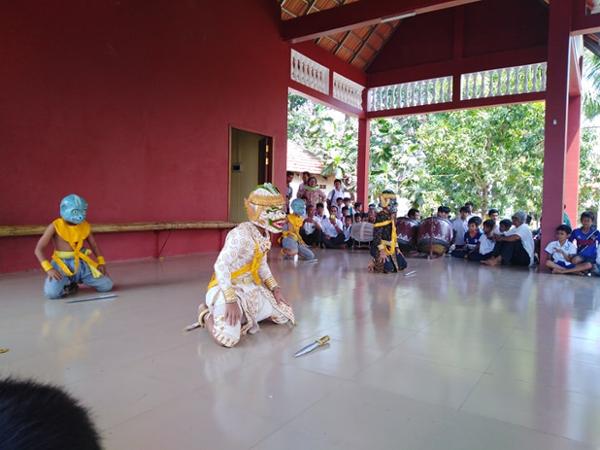
... Soon joined by the army of monkeys
The school in service of art and culture
About forty students train on this day before the performance inside the theatre. Phat, the teacher of the giants group, has about ten students aged 13 to 15. The monkeys group is much larger with about thirty children aged 9 to 10. This activity allows the village children to clear their minds and practice a dance that is, it must be said, physically very demanding. The movements must be repeated to perfection. "The movements of the back and head are paramount," Marie-Claude explains. And so as not to leave the girls out, daily classical Khmer dance training sessions are also organized in the educational space.

Phat teaches the young talent the art of the giants. ©MarionJoubert
School, art, and culture form a whole at Wat Svay Andet. Today, the overflowing motivation of each player in this system allows the village to feel the positive waves emanating from this ancestral culture, long forgotten. Marie-Claude and Hubert now wish for the village to benefit from their spectacular performances and make a living from them, to monetize this venture. Exporting the performance could be an option. Welcoming tourists as well. However, caution is warranted regarding the dangers of such development, which could lead to the loss of this seemingly immortal soul that has remained, despite human catastrophes, intact for thirteen centuries.
Thibault Bourru
Thibault BourruA passionate lover of literature and Asia, Thibault shares his experiences through his writing.