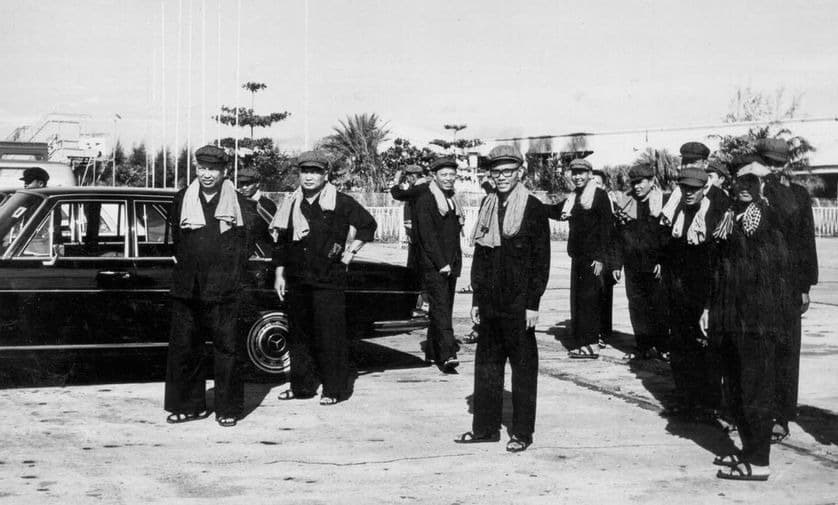
The History of the Khmer Rouge: The Beginnings (Part 1)
Vietnamese troops led by several dissident former Khmer Rouge entered Phnom Penh 40 years ago, on January 7, 1979, to end an extremely violent dictatorship that
Vietnamese troops led by several dissident former Khmer Rouge entered Phnom Penh 40 years ago, on January 7, 1979, to put an end to an extremely violent dictatorship that caused the deaths of 1.7 million people, according to estimates: that of Democratic Kampuchea. Commonly known as the Khmer Rouge, this political regime ruled Cambodge from 1975 to 1979, but the history of this movement is far broader and must be analyzed across the entire second half of the twentieth century. Here is a non-exhaustive list of significant historical facts of Khmer Rouge ideology.
1951: Creation of the Khmer People's Revolutionary Party
During the First Indochina War (1949–1954), and still under French Protectorate rule in Cambodge (1863–1953), the communist Việt Minh had to reorganize its Cambodian and Laotian allies to meet the needs of numerous local guerrilla campaigns. The Indochinese Communist Party, created in 1930, was then divided into three separate parties. Cambodge inherited in 1951, under Việt Minh supervision, the Khmer People's Revolutionary Party, a clandestine communist organization. The Vietnamese paramilitary organization placed at its head Son Ngoc Minh, a Khmer-Vietnamese mixed race who had served it at the beginning of the Indochina War. At his side, leading the moderate branch of the party, was Tou Samouth, the mentor of Saloth Sar, better known by the name Pol Pot. At the end of the war, the "Việt Minh Khmers" either surrendered or went into exile in North Vietnam, as was the case with Son Ngoc Minh. Tou Samouth then became the primary leader of the Khmer People's Revolutionary Party.
It was in the early 1950s that King Norodom Sihanouk first used the term Khmer Rouge. He invented it in opposition to other existing political denominations such as the Pink Khmers for the Democratic Party, the Blue Khmers for the Republican Party, and the White Khmers for the Royalists.
The Marxist Circle
Meanwhile, and throughout almost the entire decade, many future Khmer Rouge leaders studied in France. They all belonged to the Association of Khmer Students in France (AEK), which supported and assisted every Cambodian national pursuing studies there. From 1950 onward, and at a frequency of one to three times per month, the first discussions were organized, bringing together AEK members to discuss the Indochina War and its stakes. Ieng Sary, future Deputy Prime Minister and Minister of Foreign Affairs of Democratic Kampuchea, took charge of these round tables and named the group the "Marxist Circle". He invited notably Saloth Sar (he would adopt the name Pol Pot starting May 20, 1975), Son Sen, and Khieu Samphân (the last high-ranking Khmer Rouge dignitary still alive today). All of them adhered at that time to the French Communist Party (PCF), and engaged in reading works signed by Marx, Lenin, and Stalin during these meetings.
Upon his return to Cambodge in 1953, Saloth Sar joined forces with the Việt Minh and the Khmer People's Revolutionary Party in the maquis near Kampong Speu, and then in the eastern part of the country. He was appreciated by local leaders for his advanced education. His power to persuade the masses caught the attention of Tou Samouth, who made him his personal assistant and later elevated him to the rank of number 3 in the party.
1962: Saloth Sar Takes the Helm of the Party
In 1960, the Khmer People's Revolutionary Party was renamed the Kampuchea Workers' Party. At its head, Tou Samouth, who advocated cooperation with state leader Norodom Sihanouk, was followed in the hierarchy by Nuon Chea, Saloth Sar, and Ieng Sary. This was the first time since its creation in 1951 that the party chose its own organizational structure, outside Vietnamese oversight. At the same time, seeking secure neutrality within his government, Norodom Sihanouk promoted left-leaning figures to ministerial positions such as Khieu Samphân and Hou Yuon, the former president of the AEK, unaware that they were secretly allied with the Kampuchea Workers' Party.
On July 20, 1962, Tou Samouth disappeared under contested circumstances. Two versions clash. The first is that he was arrested and then killed in the house of the future Prime Minister and president of the Khmer Republic Lon Nol, before being buried on the outskirts of the capital. The second, that of Australian historian Ben Kiernan, recounts that he was eliminated by those close to Saloth Sar. A secret 1978 report on "internal enemies" of the party allegedly accused the secretary of Kandal province, Som Chea, of committing the crime. Later executed, he was one of the close associates of the future Pol Pot in 1962. In any case, Saloth Sar was then elected Secretary General of the party to replace Tou Samouth. With the exception of Nuon Chea, who had studied law in Bangkok, the entire clique of former Paris students, calling itself the Center, found itself at the head of the Khmer communist party. Some were moderate at that moment and wanted an association with Sihanouk for Cambodia's benefit. But Saloth Sar categorically disapproved. He wanted a revolution.