Visiting Angkor's Temples
Visiting Angkor's Temples
Located 8 km from the first temples, the charming town of Siem Reap is the "base camp" for all travelers eager to discover the treasures of the Angkor Archaeological Park (UNESCO World Heritage Site).
Located 8 km from the first temples, the charming town of Siem Reap is the "base camp" for all travelers eager to discover the treasures of the Angkor Archaeological Park (UNESCO World Heritage Site).
Spanning an area of some 400 km² partially covered in forest and dotted with a few villages, this incomparable showcase of art and architecture brings together the magnificent remains of the Khmer Empire's capital, which flourished between the 9th and 15th centuries.
No visit is possible without an Angkor Pass. This precious key that serves as your ticket comes in 3 versions. It's personalized and includes your photo (taken directly at the sales counter).
Passes are sold exclusively at "Angkor Enterprise", Street 60 (next to the Angkor Panorama Museum).
The ticket office is open daily from 5:00 AM to 5:30 PM. Passes issued after 5:00 PM are valid from the following day.
- 1-Day Angkor Pass costs $37
- 3-Day Angkor Pass costs $62
- 7-Day Angkor Pass costs $72
- Access is free for children under 12 years old who must carry a passport at all times to prove their age.
For each Pass sold, $2 is donated to Kantha Bopha Children's Hospital.
The Angkor Pass grants you access to all temples within the archaeological park (Angkor Thom, Bayon, Preah Khan, Angkor Wat, Ta Prohm…) as well as to the temples in the Roluos complex (Preah Ko, Lo Lei, and Bakong) located approximately 12 km southeast of Angkor, and to the temples of Banteay Srey and Banteay Samre, both situated north of the Park. However, specific entrance fees are required for the more distant sites of Beng Mealea ($5), Phnom Kulen ($20), Koh Ker ($10), and Preah Vihear ($10).
Passes are regularly checked at the entrance of major temples, so always keep yours with you.
Above all, do not lose your pass—otherwise you'll have to buy a new one.
Likewise, once purchased, no pass is refundable, regardless of the reason.
Opening Hours
The Angkor Archaeological Park is open daily from 7:30 AM to 5:30 PM.
Only a few temples offering sunrise and/or sunset viewing have different hours:
- Angkor Wat: 5:00 AM – 5:30 PM
- Srah Sang: 5:00 AM – 5:30 PM
- Phnom Bakheng: 5:00 AM – 7:00 PM
- Pre Rup: 5:00 AM – 7:00 PM
8 km separate Siem Reap from the first temples, and there can also be several kilometers between each site. Walking is simply not feasible unless you're an ultra-marathoner on an extended stay.
To explore comfortably, you'll have several transportation options: air-conditioned car with driver, minibus, tuk-tuk, moto-taxi, or even bicycle for the most adventurous and enduring.
Where to Begin?
Exploring all of Angkor's remains in their entirety requires considerable time, so we've narrowed down the essentials to help you discover the must-see sites.
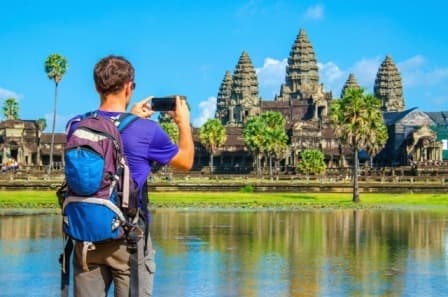
Unless you're a purist determined to start with the very first temple ever built, we recommend a spectacular introduction by prioritizing the wonderful temples around and within the Angkor Thom compound (7/8 km from Siem Reap), notably Angkor Wat, commissioned by King Jayavarman VII and symbol of the Khmer Empire's golden age during the Angkor era; Bayon with its many towers bearing colossal faces; Ta Prohm famous for its massive trees with sprawling root systems; Preah Khan and its giant causeways. By scheduling Pre Rup for late afternoon, you'll admire the sunset from the temple's heights.
Next, venture to slightly more distant sites like the Roluos complex (12 km southeast), where you'll admire Bakong among others, the first temple-mountain built on the Angkor site in the 9th century. Heading north, you'll find Banteay Srey (37 km away), a divine rose-sandstone citadel celebrated for its refined bas-reliefs, or the remarkable Kbal Spean (50 km away) with its sacred river whose riverbed is lined with unusual sculptures (lingas). Venture eastward to discover the majestic Beng Mealea (60 km away), reclaimed by nature.
Far beyond lie other gems not to miss. Thus, 90 km north of the Angkor Archaeological Park awaits Koh Ker with its pyramid-like temple-mountain reaching 30 meters; 200 km in the same direction, Preah Vihear (UNESCO World Heritage Site), perched on its rocky plateau bordering Thailand, reveals all the splendor and ingenuity of Khmer architecture while offering breathtaking views.
A Few Tips
By starting early in the morning, you'll maximize your time, suffer less from the heat, and enjoy significantly better lighting for photography. At lunchtime, you can return to your hotel to dine or cool off in the pool if it has one. However, if you choose to stay within Angkor's grounds, you'll have no trouble satisfying your hunger at one of the many charming local restaurants, or you can take advantage of fewer crowds in the temples to appreciate them more fully.
Adopt the Right Attitude
For many, Angkor remains a place of worship, prayer, and meditation. It's also a sacred site for Buddhists and a living space where over 130,000 people inhabit villages established long ago. To harmonize respect for the local population, public safety, and visitor satisfaction, a code of conduct has been established. These guidelines, far from being restrictive, simply reflect common sense. We encourage you to follow them.
Modest attire is required at sacred sites. Knees and shoulders must be covered (no shorts, miniskirts, mini-dresses, tank tops…). If you don't have anything more appropriate in your luggage, use the classic solution by covering your shoulders with a scarf and hiding your knees with a sarong. And if you lack these two accessories, head to the market and pick up some lovely kramas (large traditional Khmer scarves).
To preserve the monuments, do not touch bas-reliefs and sculptures, sit or lean on fragile structures, make graffiti, move archaeological pieces, or remove them. Additionally, high heels, tripods, and umbrellas with pointed tips are discouraged.
Adopt a calm and respectful behavior toward others. Loud noise and indecency at a sacred site are considered offensive in Cambodian culture.
Buddhist monks in orange robes always make wonderful subjects for photographs. However, respect them as they are venerated persons and ask permission before photographing them. Moreover, women must absolutely not touch them or their clothing.
For your safety and to protect the remains, strictly follow the signage posted at the sites. If certain areas are off-limits, there's a good reason. Avoid playing acrobat and watch where you step.
Don't buy anything from children, nor give them candy or money. While it may seem harsh, know that often they're pulled out of school by their families to sell items or beg. If you wish to support children, donate instead to a recognized local charity or NGO.
The Angkor Archaeological Park is a clean, non-smoking site (including outside temples). Tobacco and litter are strictly forbidden.
Know that looting and destruction of any kind, as well as nudity (breasts and genitals) are crimes severely punished by law.
Finally, we recommend wearing comfortable walking shoes rather than flip-flops and equipping yourself with a hat/cap/sun hat, sunglasses, a small towel to wipe sweat, and especially a good memory card or extra film to capture plenty of memories. Don't forget to stay hydrated. Most tuk-tuks have a cooler and stock of small water bottles, otherwise bring drinks or purchase from the street vendors present on-site.
Give it a go!
Our local experts arrange this activity for you.