The Cambodian Krama
In Cambodge, the krama transcends its status as a simple garment. A scarf, sarong, baby carrier, or bundle cloth, this checkered fabric has accompanied Khmer people through daily life for centuries.
A symbolic garment of the Khmer people, the krama is a piece of fabric worn in Cambodge. Traditionally woven from cotton, its pattern is formed by bands of a single color crossed over white bands, creating a checkerboard of small squares. The most common hues are blue, purple, red, and sometimes green.
Generally measuring between 40 to 70 cm wide and at least 140 cm long, it can also be considerably larger, serving as a sarong, a head scarf, a baby carrier, a bundle, and more. While the traditional small checkered pattern endures, modern dyes have introduced new colors. Traditionally, each province had its own color, allowing one to recognize at a glance the wearer's origin, while also distinguishing them from neighboring Thai and Laotian peoples and all foreigners in general.
History and the Cambodian Krama
Its historical origins appear to date back to the thirteenth century, as evidenced by a report from ambassador Chou Ta-Kuan, sent by Ming Emperor Yongle, who describes this garment worn by the inhabitants of the city of Angkor.
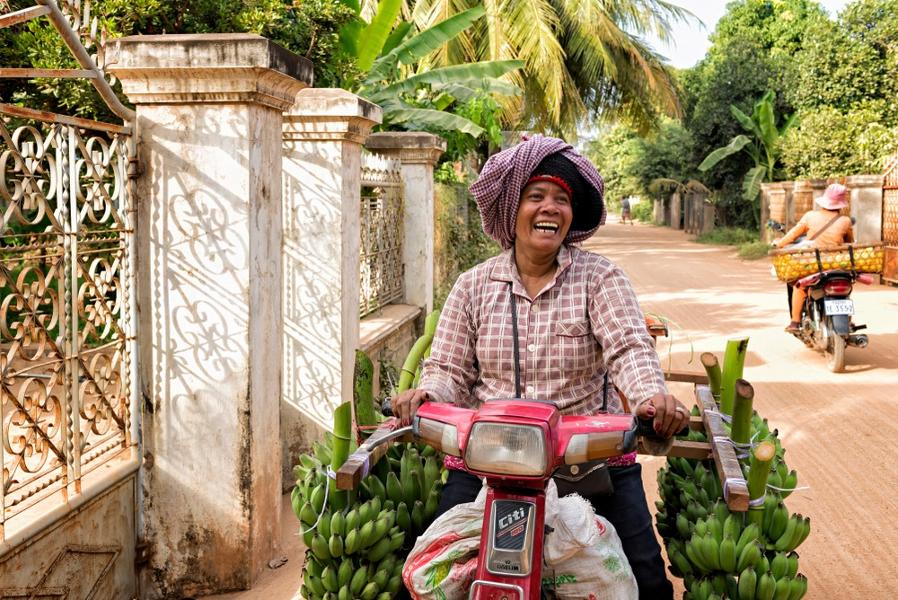
The krama, from these ancient times to the present day, is worn by all—men, women, and children. It is used on numerous daily occasions, where it fulfills many other functions. More than a simple garment, it is an indispensable accessory for Khmer peasants, rendering them countless services.
The krama might have disappeared without the Khmer people's attachment to this piece of fabric. During the colonial period, the country, under French protectorate and integrated into Indochina, had to submit to the demands of Europeans who wanted to "rationalize" the agricultural exploitation system throughout the nation. They then introduced rubber cultivation destined for rubber production, and while they promoted cotton cultivation it was for export.
Nevertheless, women always managed to harvest enough fibers to feed their traditional looms, the "key". They thus tirelessly produced this emblematic fabric, at all times and in all places, regardless of the men and policies that upheaval their country and attempted to erase their customs.
Nowadays, marked by the tragic era of the Angkar regime (1975-1979) during which it often served as a link among the condemned, the red and white krama remains poorly perceived by survivors of the massacres. It must be said that "Democratic Kampuchea" imposed it on everyone in order to purge the country of colonial capitalist influences and create a classless society…
The Krama, More Than Just Clothing for the Khmer People
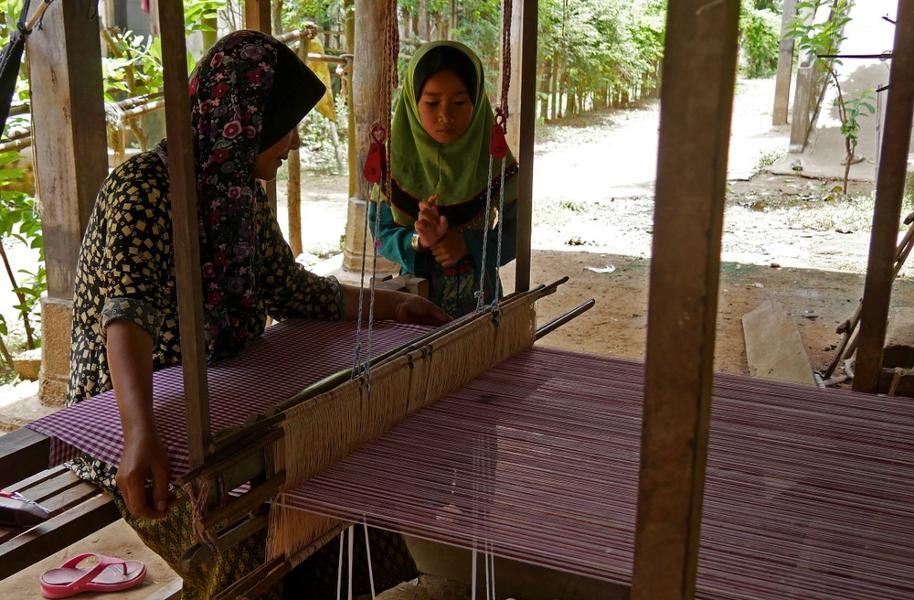
While the traditional krama, as worn by local inhabitants, is made of cotton, for a long time women have also woven silk kramas to supplement their income. It is in the Cambodian province of Kampong Cham on the eastern bank of the Mekong that most cotton kramas are produced, while silk is harvested and woven in Takéo province, in the south of the country not far from the capital Phnom Penh, where they will be sold to the wealthier, thereby marking their social status.
In a country where the economy rests primarily on agriculture and the standardized textile industry, this modest piece of authentic fabric retains all its appeal. Because of its pleasant lightness in a humid tropical climate, because its price is as modest as its appearance, and because of the multiple uses one can make of it, the krama is intimately linked to the Cambodian people.
Wherever one looks, it is present. A scarf or head covering, it protects from the bite of the sun. The Khmer do not enjoy tanning during the day; even in great heat, covering every scrap of skin is paramount for the vast majority of them. Spread generously over the head and shoulders, it shelters the bent backs of peasants laboring in the rice paddies from the wind. Tied like a pareo around the hips, it becomes a sarong (skirt) worn by all, men and women alike. Sometimes, to facilitate agricultural work, men tie it skillfully to fashion a sort of shorts that give them ease of movement.
It is also often transformed into an apron to protect another krama worn directly against the skin before wiping down the sweat-soaked bodies of peasants returning home. Sometimes still, it is stretched between two uprights of a cart where it improvises a welcome sunshade, when it does not become a hammock between two trees.
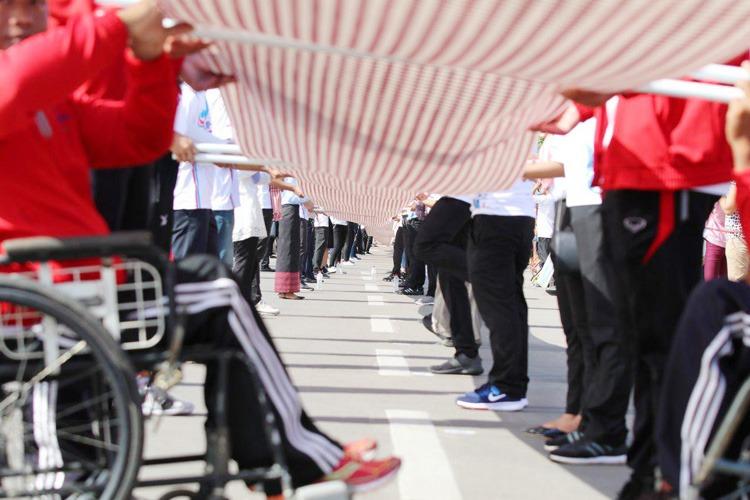
The country even claims its expertise in the crafting of the precious krama. In July 2018, tailors from Phnom Penh wove the world's largest krama, measuring 1,149 meters long by 88 centimeters wide. This is certainly symbolic but reveals the importance of this piece of fabric within Khmer territory's borders.
Its sturdy fabric often serves as a cargo carrier, a makeshift bundle, or even becomes an improvised stretcher. Children know it from their earliest age as it serves as a cozy and comfortable baby carrier, before becoming their garment and even a plaything or schoolbag. It still conceals the nakedness of bathers washing in the river, dries their bodies before clothing them anew, for it dries itself quickly.
The krama has so many uses that considering it merely as a scarf or garment is far too reductive. It is all things at once—a fabric of many facets and the symbol of an entire people. It is present at all times, in all labors, accompanying them from birth until the end of their lives.
Frequently asked questions
Authentic kramas are found primarily in the local markets of Phnom Penh, Siem Reap, and in the provinces of Kampong Cham (cotton) and Takéo (silk). Avoid tourist versions and favor markets frequented by locals.
A genuine krama is recognized by its traditional cotton weaving, its characteristic checkered patterns, and its standard size (40-70 cm wide, minimum 140 cm long). Traditional colors are blue, red, and purple on a white background.
The price of a krama varies according to quality and material: expect a few dollars for a traditional cotton krama, and more for artisanal silk versions from Takéo province.
Yes, Cambodians generally appreciate when visitors wear the krama with respect. It is even an excellent way to protect yourself from the sun while immersing yourself in local culture.