Currency in Cambodia
The Cambodian riel carries within it a rich history: currencies of the Funan Empire, colonial piastre, disappearance under the Khmer Rouge, national restoration, and coexistence with the US dollar.
The riel has not always been the official currency of Cambodia—Cambodian currency has shifted significantly over the centuries, both in form and name! Although Cambodia issued its own currency only after independence in 1953, coins circulated for more than 2,000 years, even before the rise of the Angkor Empire in the 9th century.
The beginnings of currency
From the 1st century onwards, the Funan Empire, the first kingdom to emerge in the region, covered much of Southeast Asia including Cambodia, southern Vietnam, parts of Laos, Thailand, and Myanmar, before being absorbed by Chenla in the 6th century.
The ancient Khmer people under the Funan Empire developed currency, religion, and trade with India. Indeed, currency creation appears to have developed from India, itself influenced by the Greek and Roman empires, which occupied Indian territory in antiquity.
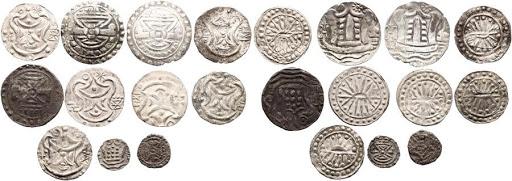
Archaeologists have discovered numerous metal, silver, and gold coins dating from the 4th century near the Angkor Borey archaeological site, in Takeo Province.
Coins appear in all sorts of forms. Currency ranges from round coins to half-round coins, quarter coins, down to one-sixth coins. A round coin could purchase a cow, while a half-round coin could buy a pig or something smaller. Even today, at Angkor Borey, people still sift along the riverbank searching for gold coins!
Funan-era coins feature decorations depicting snails, suns, moons, and portraits of Lakshmi, the consort of Lord Vishnu.
Metal coins discovered in the early first millennium in Cambodia
Currency as a driver of development
Abundant evidence has been found—copper notes, mirrors, Buddhist statues, and ceramics—portraying the Funan Empire as a rich and powerful realm, blessed with abundant natural resources where commerce flourished. Moreover, the empire represented progress in Hindu and Buddhist beliefs and prosperity for the nation.
The Khmer people were then able to develop their own currency. Currency played a central role in facilitating commercial activities, daily life, and national and international exchanges.
The creation of banknotes significantly contributed to the development of global maritime commerce. Thus, the Funan Empire evolved from a family-based economy to a communal economy and then to a social economy, ultimately expanding into the global economy through maritime trade with other empires such as India and China. At that time, the O'Keo port of the Funan Empire served as the convergence point for commercial exchanges between India and China.
King Kan produced numerous types of currency for his people, such as the Sleung and Snok currencies in the 16th century.
Recently, Cambodians discovered a gold coin from the Chenla era between the 4th and 7th centuries. Many coins bearing the effigies of Cambodia's ancient cities may yet remain undiscovered. The tradition of exchange and commerce played a major role in economic development.
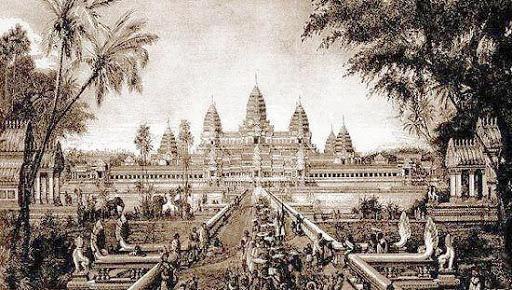
The Angkor Wat temple during the Khmer Empire
Colonial currency
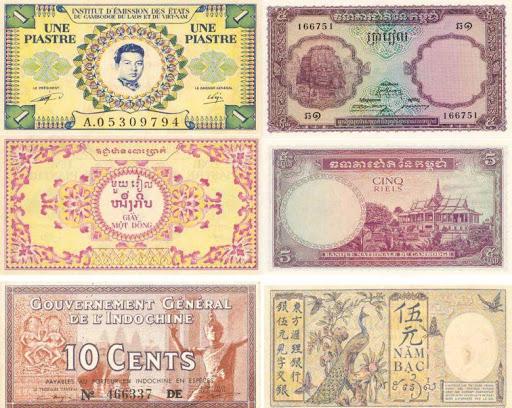
Currency continued to be used by the Khmer people until King Ang Duong, who ruled the kingdom between 1848 and 1860, before the arrival of French colonists in 1863. The French colonial government was the first to introduce paper money to Cambodia.
Following Cambodia's integration into French Indochina (Cambodia, Laos, and Vietnam), the Banque de l'Indochine was established in 1875. A branch was opened in Phnom Penh and became the banknote-issuing bank for all of Indochina from February 22, 1891 to December 31, 1951. Indochinese currency was then introduced—the piastre, divisible into 100 cents.
On December 31, 1951, the exclusive privilege of banknote issuance was transferred to the Issue Institute of the States of Cambodia, Laos, and Vietnam, which also had its headquarters in Phnom Penh. Although distinct notes were issued for Cambodia, Laos, and Vietnam, banknotes were uniform across the three states.
The Indochinese piastre divided into cents is introduced by the first French colonists in 1848
The return to national currency
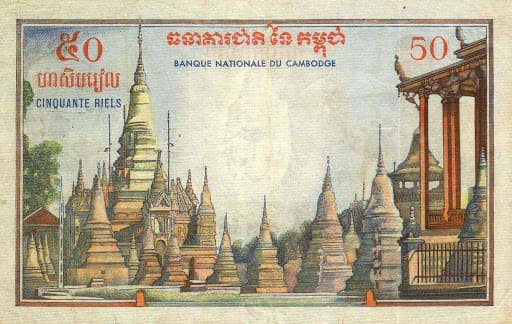
It was only when King Norodom Sihanouk achieved full independence from France on November 9, 1953 that Cambodia could reclaim its own currency. The National Bank of Cambodia, established in December 1954, successfully launched the new riel (KHR) on January 1, 1955. Cambodia was then able to determine its currency's value, issuance amounts, monetary advances to government, and to establish its own trade policy and customs regulations. The riel is divisible into 100 sen, on par with the existing piastre, which was completely replaced in September 1955.
The riel continued to be used until 1975, when the Khmer Rouge overthrew the government, abolished money, destroyed the National Bank of Cambodia, and introduced a barter economy. Under the Khmer Rouge regime, new banknotes were printed depicting the Khmer Rouge defending the country against capitalists, but they were never issued.
After the Vietnamese invasion in 1979, the riel was restored as Cambodia's currency on April 1, 1980. Facing a fragile post-war economy, the central government distributed new banknotes to the population to encourage their use.
In rural areas, the riel was then used for virtually all purchases, large and small. In Battambang and other regions near the Thai border, such as Pailin, the Thai baht is also accepted.
The face of current king Norodom Sihamoni appears on the rare 100,000-riel banknotes
The arrival of the dollar
To maintain peace and facilitate the country's disarmament, the United Nations Transitional Authority in Cambodia (UNTAC) took over Cambodia's administration in 1992. To stimulate the local economy, UNTAC decided to inject a vast quantity of US dollars. It is estimated to have spent 1.7 billion dollars, roughly 75% of Cambodia's GDP at the time.
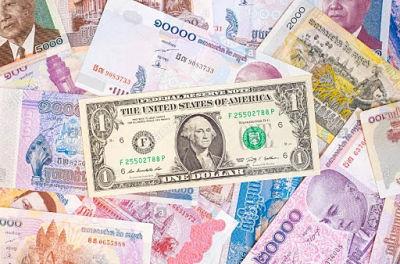
Cambodia's currency system became a "dual currency" arrangement. The riel remains in competition locally with the US dollar, which is often regarded as Cambodia's second unofficial currency. US dollars represent 80% of actual currency in circulation! Currently, the exchange rate is approximately 1 USD = 4,053 KHR = 0.86 EUR. More than 90 countries worldwide employ this dollarization policy to promote market development.
Withdrawing the dollar from Cambodia today would severely disrupt the economy and trigger significant inflation.
Riels today
Rather than suddenly de-dollarizing the economy at the risk of destabilizing macroeconomic stability and growth through capital flight, the National Bank of Cambodia encourages gradual riel adoption and market mechanisms.
To promote riel banknotes, they are decorated with images evoking Cambodian heroes, the people, and economic development to foster solidarity. This effort is supported by the stability of the riel's value and by daily usage of riels in most rural areas.
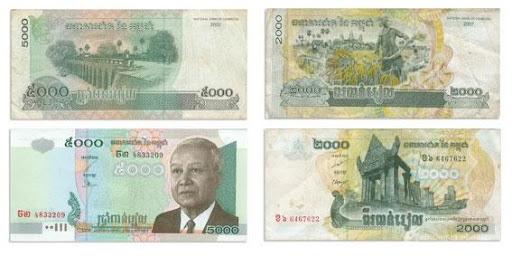
Riel banknotes also represent historical and cultural events as well as economic progress. The smiling face of a female farmer harvesting rice appears on the reverse of the 2,000-riel note, acknowledging the vital importance of the agricultural sector. On the other side, a triumphant illustration of the Preah Vihear temple, inscribed as a UNESCO World Heritage site in 2008, highlights the richness of Cambodian culture.
Frequently asked questions
In Cambodia, you can use both the Cambodian riel (KHR) and the US dollar. The dollar is widely accepted, especially in cities, while the riel is more common in rural areas.
You can exchange money at banks, official money exchange offices, and some hotels. ATMs are available in major cities.
The exchange rate fluctuates, but it is generally around 4,000 riels per 1 US dollar. It is advisable to check the current rate before your trip.
Visa and Mastercard are accepted in hotels, restaurants, and shops in major cities like Phnom Penh and Siem Reap, but less so in rural areas.
